COBOL to Java migration has been a long-standing goal for enterprises, yet it remains one of the most complex and high-risk modernization efforts in software engineering. The difficulty is not converting syntax from one programming language to another—it is preserving decades of business logic embedded deep inside COBOL systems.
Banks, insurance companies, governments, and large enterprises still rely on COBOL because these systems encode mission-critical rules such as transaction validation, eligibility checks, pricing formulas, and regulatory compliance logic. Losing or altering even a small portion of this logic during migration can lead to serious financial, legal, and operational consequences.
This is where AI-driven COBOL to Java migration changes the approach. Instead of rewriting systems blindly, AI focuses on understanding and protecting what matters most: business behavior.
Why COBOL to Java Migration Is So Difficult
At first glance, COBOL code may appear procedural and straightforward. In real production environments, however, most COBOL systems are:
- Built over decades through thousands of incremental changes
- Light on documentation and heavy on implicit rules
- Closely tied to batch workflows, file processing, and mainframe platforms
- Dependent on edge cases that only appear under real-world conditions
Traditional migration projects often fail because they treat COBOL as merely “old code” instead of recognizing it as a living model of business operations.
The true risk is not technical incompatibility—it is loss of business logic.
How Business Logic Is Embedded in COBOL Applications
In COBOL systems, business logic is rarely centralized or neatly documented. Instead, it is distributed across:
- Conditional branches
- Numeric precision handling
- Date and time calculations
- File and record processing rules
- Error-handling routines
- Batch sequencing and job dependencies
Many of these rules exist only in code. They are not captured in documentation, diagrams, or requirements manuals. Any successful migration must first extract, preserve, and validate this logic before translating it into a modern language.
How AI Changes COBOL to Java Migration
AI-driven modernization approaches COBOL migration differently from traditional tools.
Rather than performing a simple line-by-line translation, AI systems:
- Analyze the entire COBOL codebase, not isolated programs
- Trace execution paths and data flows across jobs and modules
- Identify and document business rules explicitly
- Model COBOL-specific behaviors such as numeric precision and file I/O
- Generate equivalent Java logic that mirrors original outcomes
- Create automated tests to verify functional parity
This approach allows organizations to modernize systems without changing what they actually do.
Example: Preserving Business Logic in COBOL to Java Migration
To understand how AI preserves logic during migration, consider a simplified example that illustrates real-world behavior.
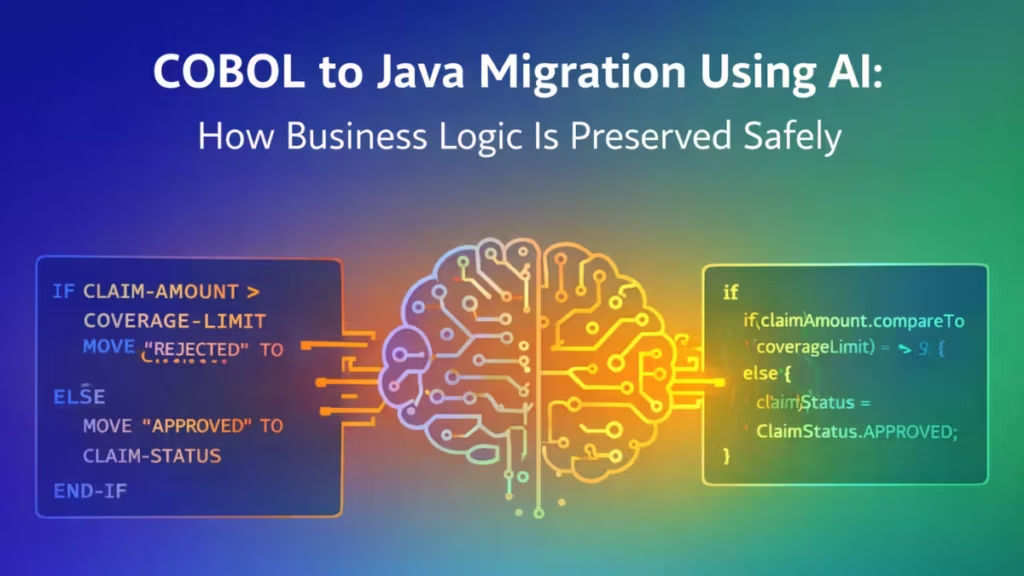
Illustrative COBOL logic:
IF CLAIM-AMOUNT > COVERAGE-LIMIT
   MOVE "REJECTED" TO CLAIM-STATUS
ELSE
   MOVE "APPROVED" TO CLAIM-STATUS
END-IF
This logic represents a core business rule: claims exceeding coverage limits are rejected.
Equivalent Java logic generated during AI-assisted migration:
if (claimAmount.compareTo(coverageLimit) > 0) {
    claimStatus = ClaimStatus.REJECTED;
} else {
    claimStatus = ClaimStatus.APPROVED;
}
The goal of AI-driven migration is not cosmetic translation, but exact preservation of decision flow, numeric behavior, and execution order, while expressing the logic in a modern, maintainable Java structure.
Step-by-Step: AI-Driven COBOL to Java Migration
1. Deep Code Analysis
AI tools parse COBOL programs, copybooks, and job flows to build a complete model of how the system operates.
2. Business Rule Extraction
Implicit rules—such as validations, thresholds, and calculations—are identified and documented automatically.
3. Behavior Modeling
COBOL-specific behaviors like packed decimals, file sequencing, and batch dependencies are modeled so the Java system behaves identically.
4. Java Code Generation
The system produces clean, readable Java code using modern frameworks while maintaining original business logic.
5. Automated Test Creation
AI generates test cases based on real execution paths, ensuring the Java system produces the same results as the COBOL system.
6. Incremental Validation
Both systems run in parallel until outputs are verified as functionally equivalent, reducing risk and avoiding “big-bang” failures.
How AI Reduces Risk in COBOL to Java Migration
Manual migration depends heavily on human interpretation, which introduces risk because:
- Developers may misunderstand legacy rules
- Edge cases can be overlooked
- Assumptions may replace proven production behavior
AI, by contrast, evaluates actual code behavior, not assumptions. It preserves logic by observing how systems truly operate, not how they are expected to operate. This is especially critical in regulated industries where even small deviations can result in compliance issues.
COBOL to Java Does Not Mean Losing Stability
A common concern is that moving to Java sacrifices the reliability traditionally associated with COBOL systems. When done correctly, the opposite is true.
AI-assisted migration enables:
- Modern runtime environments
- Improved observability and monitoring
- Stronger security controls
- Easier API and cloud integration
- Faster and safer feature development
All while preserving the same business outcomes that made COBOL systems reliable in the first place.
When Enterprises Should Consider COBOL to Java Migration
AI-driven COBOL migration is particularly valuable when:
- COBOL expertise is becoming scarce
- Systems must integrate with modern platforms
- Batch processing limits real-time services
- Maintenance costs continue to rise
- Innovation is blocked by legacy tooling
This approach is not about abandoning COBOL overnight—it is about making proven systems future-ready.
COBOL to Java migration has failed many times in the past—not because it was unnecessary, but because it was approached incorrectly. AI changes that by prioritizing preservation before transformation.
For enterprises that depend on COBOL, AI-driven migration offers a practical path forward: modern platforms, safer transitions, and business logic that remains intact.

