The next big desktop CPU battle may not happen in 2026 after all. New leaks suggest that Intel Nova Lake-S and AMD Zen 6 Ryzen desktop processors could both arrive in early 2027, potentially sharing the spotlight at CES 2027.
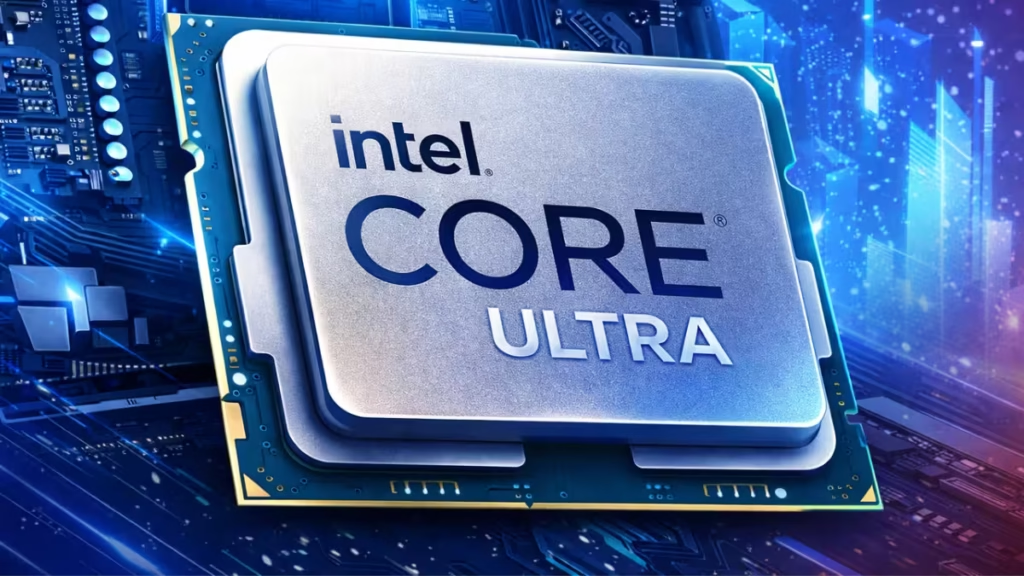
Multiple reports now point to a launch delay affecting both chipmakers. If accurate, the shift would set up one of the most competitive desktop refresh cycles in recent years.
Intel Nova Lake-S May Slip to Early 2027
Intel originally appeared to target late 2026 for its Core Ultra Series 4 desktop lineup, built on the Nova Lake-S architecture. However, well-known leakers HXL and Golden Pig Upgrade now claim that Intel could shift the launch window to CES 2027.
If that timeline holds, Nova Lake-S will arrive roughly alongside AMD’s Zen 6 desktop platform instead of preceding it.
Rumored Core Configurations
Leaked information suggests aggressive scaling across the stack:
- High-end models: Up to 52 total cores
- 16 Performance cores
- 32 Efficiency cores
- 4 Low-Power cores
- Entry-level models:
- 4 Performance cores
- 4 Efficiency cores
- 4 Low-Power cores
These figures remain unconfirmed, and Intel has not officially detailed final configurations. Still, the rumored core counts point to a major push in multi-threaded performance.
Stronger Focus on AI and NPU Performance
Another highlight from early leaks involves significantly improved NPU (Neural Processing Unit) performance. Intel appears to prioritize on-chip AI acceleration as AI workloads become central to Windows and desktop productivity environments.
This move aligns with broader industry trends, especially as Microsoft continues expanding AI integration across Windows platforms.
AMD Zen 6 “Olympic Ridge” Also Reportedly Targeting 2027
Intel may not be alone in delaying its next desktop generation. According to Benchlife, AMD’s Zen 6 desktop Ryzen lineup, often referred to in leaks as “Olympic Ridge,” may not launch in 2026 as previously expected .
The outlet describes 2027 as the earliest launch window for the Zen 6 desktop family.
AM5 Platform Compatibility?
Leaks suggest that Olympic Ridge could continue using the AM5 socket, potentially extending motherboard support across multiple generations.
If AMD maintains AM5 compatibility, existing 800-series chipset boards may remain viable. However, AMD has not officially confirmed desktop timing or platform details.
It’s important to note that AMD has publicly tied Zen 6 to its EPYC “Venice” server lineup and previously indicated a 2026 timeframe for that segment . Desktop availability could follow later.
Why Intel and AMD Are Pushing Desktop CPU Launches to 2027
Industry-wide factors may influence these shifts:
- Ongoing silicon supply constraints
- DRAM availability concerns
- Extended platform validation cycles
- Increasing architectural complexity
Earlier reporting suggested that product launch cycles across the PC industry could lengthen due to supply-chain pressure . A synchronized 2027 launch window now appears plausible.
If Intel and AMD both choose CES 2027, the desktop CPU market could see a direct generational showdown rather than staggered releases.
If Nova Lake-S and Zen 6 both land in early 2027:
- 2026 may focus more on mobile and server segments
- Desktop upgrades could pause for a longer refresh cycle
- Consumers may benefit from more mature platforms at launch
- Competition could intensify immediately at release
For now, both roadmaps remain based on leaks. Neither Intel nor AMD has officially confirmed CES 2027 desktop launches.
Still, if these reports prove accurate, early 2027 could mark one of the most important years for desktop CPU innovation in a decade.

