Microsoft has officially rolled out native MIDI 2.0 support in Windows 11, delivering the biggest MIDI upgrade on the platform in decades. The update arrives through Windows MIDI Services, a rebuilt MIDI stack that supports both MIDI 1.0 and MIDI 2.0 without breaking compatibility with existing apps.
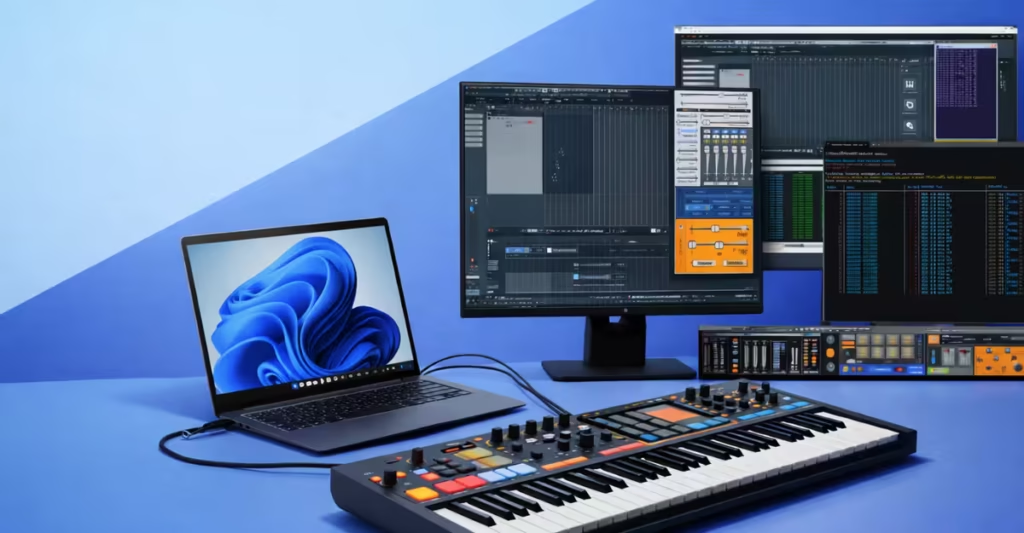
For musicians and producers, MIDI is not just about old .mid files. It is the backbone of modern electronic music, syncing instruments, software, lighting, and effects. While MIDI 1.0 has powered music workflows since 1983, its technical limits have long frustrated creators. Windows 11 now removes many of those bottlenecks.
How MIDI 2.0 Improves Music Production on Windows 11
Native MIDI 2.0 brings bidirectional communication, automatic device discovery, higher-resolution controls, and uncapped data speeds. Windows MIDI Services handles protocol negotiation automatically, allowing MIDI 2.0 hardware to work seamlessly with older MIDI 1.0 apps through real-time translation and scaling.
Microsoft has also completely rewritten its legacy MIDI 1.0 code, improving stability and performance across the board. Existing MIDI software benefits immediately, even without updates .
Multi-Client MIDI Is Finally Here
One of the most requested features from Windows users is now live: multi-client MIDI access. Multiple apps can use the same MIDI device at the same time without relying on vendor-specific drivers. Producers can now run DAWs, plugins, and utility tools together without fighting over MIDI ports.
This works across both MIDI 1.0 and MIDI 2.0 devices and applies system-wide.
Built-In Loopback and App-to-App MIDI
Windows 11 now includes native MIDI loopback. Apps can send MIDI data directly to other apps without extra drivers or virtual cables. Even browser-based WebMIDI tools can participate in these workflows.
Developers can also configure apps to behave like full MIDI 2.0 devices, complete with discovery and protocol negotiation, while still remaining compatible with classic MIDI APIs.
Better Timing and High-Resolution Control
Timing accuracy has improved significantly. Windows MIDI Services supports microsecond-level timestamps for incoming and outgoing MIDI messages, along with scheduled message delivery. This results in tighter playback, better synchronization, and more consistent performance across devices.
High-resolution MIDI 2.0 controllers now deliver their full data precision to supported apps, while older apps automatically receive scaled MIDI 1.0 values.
New USB MIDI Driver in Windows 11 and Future MIDI Plans
Microsoft has introduced a new USB MIDI 2.0 class driver alongside improvements to the existing MIDI 1.0 driver. The new driver follows modern power-management standards and supports both MIDI generations.
Looking ahead, Microsoft confirmed plans for Network MIDI 2.0, additional transports like Bluetooth LE MIDI, a virtual MIDI patch bay, and an in-box low-latency USB audio driver with ASIO support.
For musicians who have waited years for a proper MIDI overhaul on Windows, this update finally delivers.

