Board games have enjoyed a remarkable resurgence in recent years. People are rediscovering the joy of gathering around a table, rolling dice, strategizing with friends, and experiencing tactile gameplay that digital entertainment doesn’t always provide. But behind every polished game that hits living rooms and game nights is a messy, creative, trial-and-error process. Central to that journey is the step where designers create board game prototype versions of their ideas before the final product is made.
Whether you’re an aspiring designer or simply curious about how your favorite games were born, understanding the role and value of prototypes can deepen your appreciation for the craft.
What Is a Board Game Prototype?
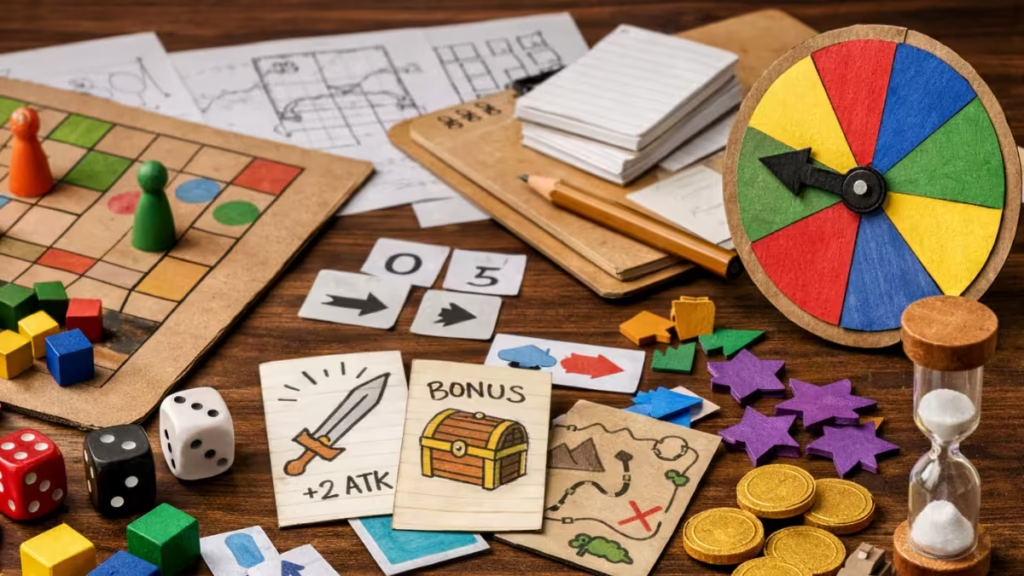
At its core, a prototype is an early model of something. In board games, a prototype is a basic version of the game used to test ideas before the final design and production. It might consist of index cards, hand-drawn boards, makeshift tokens, or simple printed cards. These early forms are meant for experimentation, not aesthetic beauty.
Prototypes are where ideas become playable. They let designers move out of abstract thought and into tangible interaction. It’s one thing to imagine a mechanic that forces players to choose between risk and reward; it’s another to watch players grapple with that choice around a table.
Why You Should Create Board Game Prototype First
1. Turn Ideas Into Playable Experiences
The most important reason to create board game prototype versions is to play with your idea. A game might look brilliant on paper, but until people interact with it, there’s no way to know if the mechanics are fun, balanced, or confusing. A prototype brings theoretical ideas into the real world where human behavior tests them.
2. Find Flaws Early and Save Time
Prototyping is about exploration and discovery. When you test early, you find problems before too much has been invested. For instance, a scoring system might look fair but result in runaway leaders during play. Catching that early with a prototype saves hours of rewriting rules later.
3. Encourage Iteration and Improvement
Game design is rarely linear. It usually involves trying something, seeing how it works, adjusting, and then trying again. Creating game prototypes encourages iteration. You might discover new strategies or unintended consequences that shift the direction of your game entirely. That’s not a setback—it’s progress.
4. Gather Honest Feedback
It’s easy to be biased about something you create. A prototype opens the game up to fresh eyes. When others play your prototype, they reveal what’s intuitive, what’s confusing, and what feels satisfying. Players often point out issues or opportunities that the designer never considered.
5. Improve Communication with Collaborators
If you’re working with artists, manufacturers, or other designers, prototypes give them something concrete to respond to. A mechanic described in words might mean one thing to you and something else to an artist. But a prototype shows exactly how pieces interact, how a turn flows, and what the pacing feels like.
Common Steps When You Create Board Game Prototype
Most designers follow a similar path as they bring a prototype to life:
- Start with a Concept
Whether inspired by a theme, a mechanic, or a problem you want to solve, begin with an idea. Jot down core rules and goals. - Draft the First Version
Use simple materials like cards, paper tokens, dice, and markers to build the first playable version. Don’t worry about art or polish. - Playtest Small
Play the game yourself first. It helps clarify whether the idea works and what needs tweaking. - Playtest Broadly
Invite others to try your prototype. Diversity of players—different ages, game experience, and perspectives—will uncover more insights. - Iterate Based on Feedback
Adjust rules, refine components, and repeat playtests. Each version gets closer to your ideal game. - Polish the Prototype
When mechanics solidify, upgrade quality. This is when clearer cards, nicer components, and a more finished prototype make future tests more meaningful.
Beyond Mechanics: Why Prototypes Shape the Player Experience
Prototyping isn’t just about testing rules or balance. It helps designers understand how players feel during a game. Does the pacing build tension? Do decisions feel meaningful? Is the endgame exciting or anticlimactic?
A prototype lets designers observe these emotional responses, not just mechanical function. That’s why the best games in the world are rarely the ones with the simplest rules but those that create memorable experiences. And those experiences emerge only after prototyping and refinement.
Prototyping Encourages Creative Confidence
Perhaps the most overlooked benefit of creating game prototypes is how it builds confidence and skill. Designers who embrace prototyping learn to iterate, to take risks, and to refine ideas without fear of failure. That mindset translates beyond games into other creative fields, whether writing, engineering, teaching, or product design.
Final Thoughts
To create board game prototype versions is to embark on a creative journey that transforms abstract ideas into something playable, social, and engaging. Prototypes are where imagination meets reality. They reveal weaknesses, highlight strengths, and guide designers toward games that resonate with players.
Game prototypes are not merely preliminary steps—they are the foundation on which great games are built. As anyone who’s ever gathered friends around a prototype can tell you, it’s in those early messy versions that the magic often begins.

