
Most Dallas small business owners hit the same wall. Sales grow, transactions pile up, and the books start eating evenings and weekends. At that point you have three options: keep doing it yourself, hire a bookkeeper, or hand the work to an outside firm.
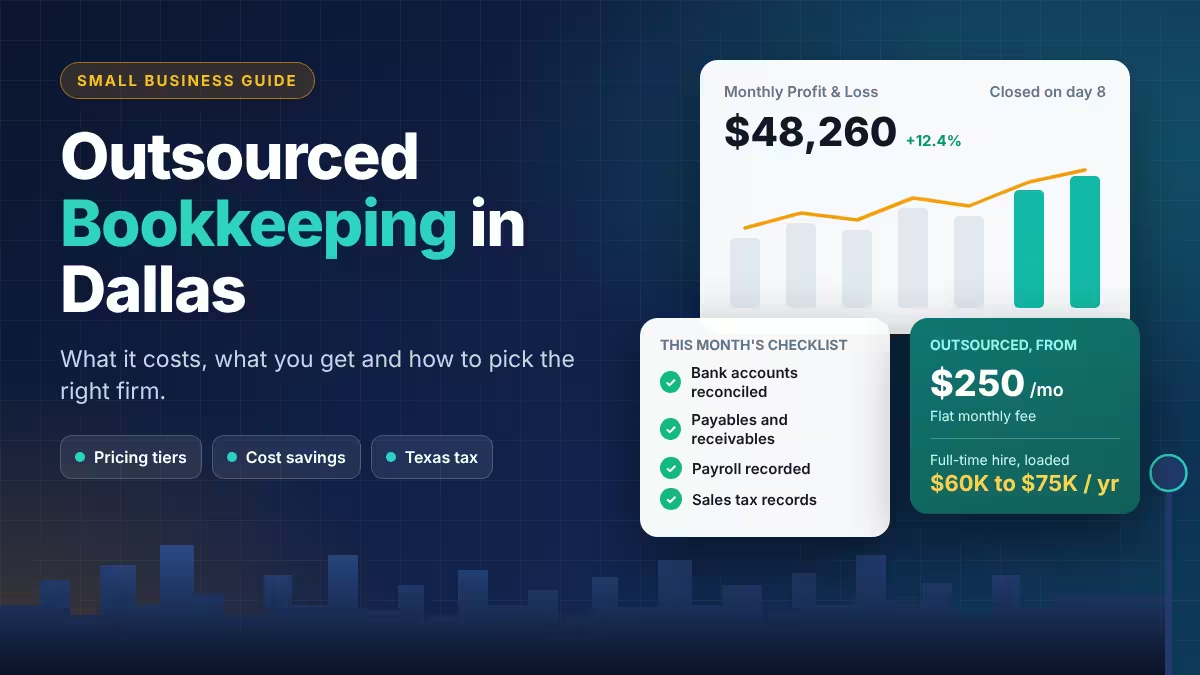
This guide breaks down what each option really costs in the Dallas-Fort Worth market, what an outsourced team actually does every month, and how to tell whether your business is ready to make the switch.
What Does Outsourced Bookkeeping Include for a Dallas Small Business?
An outsourced bookkeeping firm takes over your daily financial records without joining your payroll. The firm logs into your accounting software (usually QuickBooks Online or Xero), categorizes transactions, reconciles every bank and card account, and sends you financial statements each month.
You keep ownership of the file. The firm does the work and answers your questions. Most providers work remotely through cloud tools, so a firm in Plano or Pflugerville can serve a shop in Deep Ellum just as easily as one down the street.
How Much Does Outsourced Bookkeeping Cost in Dallas?
Price depends on workload, not on your zip code. Still, local numbers help you spot a fair quote.
Typical Monthly Pricing Tiers
| Service level | Monthly fee | Who it fits |
|---|---|---|
| Basic | $250 to $500 | Fewer than 50 transactions a month, one or two accounts |
| Standard | $500 to $900 | Businesses earning roughly $250K to $1M a year |
| Premium | $900 to $2,500 | Revenue above $1M, payroll, inventory, or multiple entities |
A recent price survey of DFW firms that publish their rates put the median entry price at about $300 a month. National online providers came in higher, with a median near $399 a month. Startup LLCs in Dallas commonly pay somewhere between $300 and $800 a month once payroll or extra accounts enter the picture.
One-Time Cleanup Fees
If your books are months or years behind, expect a separate catch-up project before monthly service starts. Firms price cleanup by transaction count and the number of months missing. Among firms that charge per month of backlog, starting prices sit around $195 for each month behind.
What Affects Your Monthly Bookkeeping Fee in Dallas?
Two businesses with identical revenue can get very different quotes. A consultant billing $500,000 a year through a few dozen invoices needs far less work than a restaurant running thousands of card sales through the same revenue.
These factors move the price most:
- Transaction volume. Every line on every statement needs review and categorization.
- Number of accounts. Each bank account, credit card, and loan requires its own monthly reconciliation.
- Payroll. Wages, withholding, and benefits add recording and compliance work.
- Inventory. Cost of goods sold and stock values need monthly updates.
- Multiple entities. Every LLC needs separate books.
- Reporting depth. Job costing, budgets, cash flow forecasts, and lender reports all add analysis time.
Industry matters too. A trucking company tracks fuel, mileage, and IFTA records. A construction firm needs job costing and careful 1099 contractor tracking. An ecommerce store has to split marketplace payouts into sales, fees, and refunds. Choose a firm that already handles businesses like yours.
Hourly vs Flat Monthly Pricing: Which Is Better for a Small Business?
Bookkeepers in the Dallas area bill in two ways, and the choice changes how predictable your costs stay.
Freelancers commonly charge $25 to $45 an hour, and some firms quote $50 to $100 an hour when they bill by the clock. Most established firms now sell a flat monthly fee tied to a written scope instead.
| Point | Hourly billing | Flat monthly fee |
|---|---|---|
| Budgeting | Moves with every month's workload | Stays the same for the agreed scope |
| Questions | Each call can add to the bill | Questions come with the service |
| Messy months | Costs rise when the books get harder | The scope sets the price, and you review big changes together |
| Best fit | One-off projects or very irregular needs | Ongoing monthly bookkeeping |
Choose hourly billing for a short project, such as a single year-end cleanup. Choose a flat fee if you want the same bill every month and the freedom to ask questions without watching a timer.
Is Outsourced Bookkeeping Cheaper Than Hiring a Bookkeeper in Dallas?
A full-time hire looks simple until you add up the real bill.
The Full Cost of an Employee
The Bureau of Labor Statistics puts the median wage for bookkeeping clerks in the Dallas-Fort Worth-Arlington metro at about $51,720 a year, or roughly $4,310 a month. The Texas statewide median runs slightly lower at around $48,910. You can check current figures on the BLS bookkeeping occupation page.
Salary is only the start. You also pay:
- The employer share of Social Security and Medicare
- Texas unemployment tax
- Health insurance, paid time off, and retirement contributions (benefits average around $13,000 per employee a year)
- A computer, software subscriptions, and desk space
- Recruiting and training, which industry estimates put near $4,700 per hire
Add it up and a full-time bookkeeper typically costs $60,000 to $75,000 a year. Even a premium outsourced plan at $2,500 a month totals $30,000 a year, less than half that figure.
Side-by-Side Comparison
| Factor | In-house bookkeeper | Outsourced firm |
|---|---|---|
| Annual cost | $60K to $75K fully loaded | $3K to $30K depending on scope |
| Who checks the work | Usually the owner, or nobody | Senior staff review before delivery |
| Vacation and sick days | Books stop | The team covers the work |
| Turnover | You restart hiring and training | The firm keeps continuity |
| Skill range | One person's experience | Bookkeepers, senior accountants, sometimes a CPA |
| Idle time | You pay for slow weeks | You pay for the work your books need |
An in-house hire starts to make sense once your volume truly fills a 40-hour week and you need someone physically on site. Most small businesses never reach that point, which is why outsourcing to cut overhead costs appeals to so many owners.
What Does DIY Bookkeeping Really Cost a Dallas Business Owner?
DIY bookkeeping feels free. It rarely is.
Owners who handle their own books typically spend 8 to 15 hours a week on financial tasks. If your time bills at $150 an hour, five hours a week alone costs you $39,000 a year in work you could have sold instead. Push that to 10 hours and the number climbs past $75,000.
Errors cost money as well. A miscategorized expense or a missed deduction raises your tax bill, and many common filing mistakes trace back to messy records. When a tax preparer receives disorganized books, they charge extra to rebuild your records before filing even starts. Accountants report spending a large share of tax season fixing exactly this kind of DIY mess. Errors found after filing can force an amended tax return.
Fraud risk deserves a mention too. When one person pays the bills and also reconciles the bank account, nobody catches mistakes or theft. Studies on small business fraud show detection often takes more than a year. An outsourced team splits those duties across several people, which builds in a natural check.
Benefits of Outsourcing Bookkeeping, Including Texas Tax Compliance
Predictable Costs
A flat monthly fee covers an agreed scope. You budget the same amount each month and only revisit the price when your business grows significantly.
A Team Instead of One Person
Many Dallas firms assign a bookkeeper for daily entries, a senior accountant to review the close, and controller or CFO support for larger decisions. You get three levels of expertise for less than the cost of one employee.
Faster, Cleaner Financial Statements
Good firms close each month within a set window, often between the 5th and the 15th of the following month. You get a profit and loss statement, balance sheet, and cash flow statement while the numbers still matter for decisions.
Texas Tax Compliance
Texas skips personal and corporate income tax but brings its own filings:
- Franchise tax. Most entities file an annual report with the Texas Comptroller by May 15, even when no tax is due. Businesses under the no-tax-due revenue threshold still need to file, and skipping the report can cost your entity its good standing.
- Sales tax. Sellers of taxable goods and services collect the 6.25% state rate plus local rates of up to 2%. Dallas businesses usually land at the 8.25% combined maximum.
- Unemployment tax. Employers file quarterly wage reports with the Texas Workforce Commission.
A bookkeeper who knows these filings keeps your records lined up so each return matches the books.
Bank and Buyer Readiness
Lenders want clean statements before they approve an SBA loan, and many Dallas banks ask for two years of them. Buyers want proof that your margins are real. Professional books give you both without a last-minute scramble.
When Should a Dallas Small Business Outsource Its Bookkeeping?
Watch for these signs:
- You or your office manager spend evenings on bookkeeping
- Monthly numbers show up late, or only when your tax preparer asks
- One part-time bookkeeper is the only person who understands your books
- Your bank balance no longer tells you whether you made a profit
- You crossed roughly $250,000 in annual revenue, added employees, or started carrying inventory
- You plan to apply for financing or sell the business in the next few years
A solo founder with simple income, one account, and spare time can reasonably manage the books alone for a while. Once complexity arrives, mistakes start costing more than professional help.
How to Choose the Best Bookkeeping Company in Dallas
Ask the Right Questions
Before you sign, get clear answers on:
- Which accounts will you reconcile every month?
- Which reports will I receive, and by what date?
- Do you charge separately for setup, cleanup, or year-end close?
- Who handles payroll records, 1099s, and sales tax filings?
- How does the fee change if my transaction volume grows?
- Do I keep ownership of my QuickBooks or Xero file?
A written quote should answer all six. If it leaves any of them vague, ask before you commit.
Check Credentials and Software Skills
Texas does not require a license to practice bookkeeping, so credentials help you separate serious firms from hobbyists. Look for certifications such as the Certified Bookkeeper (CB) designation, QuickBooks ProAdvisor status, or Xero Advisor certification. A CPA on staff or a CPA partner firm is a plus if you want tax filing handled by the same team.
Prepare for the First Call
Bring the last three months of bank and credit card statements, your most recent business tax return, a list of employees and contractors, and read-only access to your accounting software. With these in hand, a firm can size your workload and quote an accurate price.
Local Dallas Firm vs Virtual Bookkeeper: Which Should You Pick?
Cloud software lets almost any firm serve a Dallas client, so the real question is how much local knowledge and face time you want.
A Dallas-Fort Worth firm usually knows Texas filings well, works in your time zone, and will meet in person or pick up the phone. A national online provider leans on software and a support queue. It often treats the business tax return as an add-on, and you may deal with a different person each time you write in.
Compare these points before you decide:
- Where the team works, where your financial data is stored, and how it protects business accounts with multi-factor login
- Whether the firm files Texas sales tax, franchise tax and quarterly wage reports
- How quickly you get an answer from a real person
- Whether tax return preparation comes from the same books
Price alone should not decide it. Among DFW firms that publish a rate, the median entry price sits near $300 a month, below the roughly $399 median for national online providers.
How to Lower Your Bookkeeping Costs
You control part of the workload. These habits shrink your fee:
- Keep business and personal spending in separate accounts
- Connect bank feeds directly to your accounting software
- Capture receipts the day you spend, using a phone app or expense management software
- Close unused bank and credit card accounts
- Stay current every month so you never pay for cleanup
Bookkeeping fees also count as an ordinary business expense, so they reduce your taxable income.
Frequently Asked Questions
How much does a bookkeeper cost per month for a Dallas small business?
Most Dallas small businesses pay between $250 and $900 a month. Simple businesses with one or two accounts often pay near $300, while companies with payroll, inventory, or over $1M in revenue can pay $900 to $2,500.
Is outsourcing cheaper than hiring a bookkeeper?
Yes, for most small businesses. A full-time DFW bookkeeper costs $60,000 to $75,000 a year once you add taxes and benefits. Even the most expensive outsourced plans usually cost less than half of that.
Do Texas bookkeepers need a license?
No. Texas does not license bookkeepers. Certifications such as Certified Bookkeeper or QuickBooks ProAdvisor show training and skill, but the law does not require them.
Can an outsourced bookkeeper handle Texas sales tax and franchise tax?
Many can. Ask during your first call whether the firm prepares and files sales tax returns and the annual franchise tax report, or whether it only keeps the records your tax preparer uses.
Do I still need a bookkeeper if I use QuickBooks?
Yes, in most cases. QuickBooks automates data entry, but it cannot confirm that each transaction lands in the right category for tax purposes. A bookkeeper reviews the entries, reconciles your accounts, and catches errors before they reach your tax return.
What is the difference between a bookkeeper and a CPA?
A bookkeeper records and reconciles your daily transactions and produces monthly statements. A CPA analyzes that data, plans your taxes, and prepares and signs returns. Clean books from a bookkeeper usually lower your CPA's fees, since the CPA spends less time fixing records.
How much does bookkeeping cleanup cost in Dallas?
Cleanup is a one-time project priced by the number of transactions and how many months the books run behind. Firms that charge per month of backlog often start near $195 a month behind. Cleanup costs more than regular upkeep, but it is necessary before an SBA loan application or an audit.
How long does it take to switch to an outsourced firm?
Onboarding usually takes two to four weeks. Cleanup of past months can add more time if your books are behind.
Do I lose control of my financial data?
No. Reputable firms work inside your own QuickBooks Online or Xero account, so you keep ownership and full access at all times.
Can I cancel an outsourced bookkeeping contract?
Many firms run month to month with about 30 days of written notice. Confirm the cancellation terms in writing before you sign.