OpenAI has officially launched the Codex app for macOS, a dedicated desktop interface designed to help developers manage multiple AI agents, run tasks in parallel, and supervise long-running development work from a single command center. The release marks a major step in OpenAI’s push toward scalable, agent-driven software development.
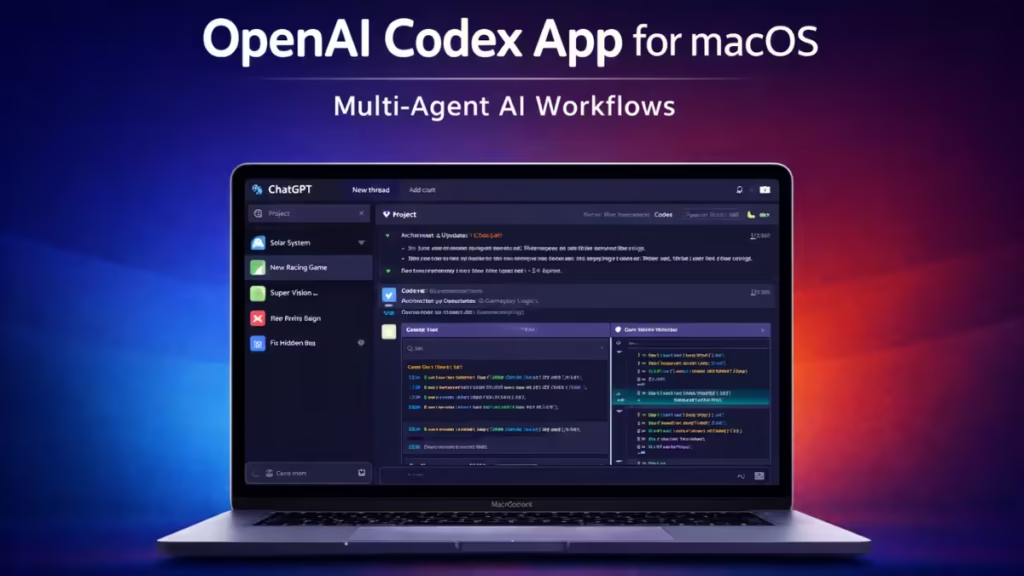
The new app builds on Codex’s evolution since its initial launch in April 2025, shifting the focus from single-agent code generation to full project orchestration. Instead of working inside traditional IDEs or terminals, developers can now direct and monitor several agents at once without losing context.
Codex App for macOS Simplifies Multi-Agent Management
The Codex app organizes agents into separate project-based threads, allowing developers to switch between tasks instantly. Each agent works independently, while the app tracks progress, changes, and decisions in real time. Developers can review code diffs directly in the interface, leave comments, or open edits in their local editor when manual changes are required.
See also: OpenClaw Patch Fixes One-Click RCE Bug Exploited Through Malicious Links
Built-in Git worktree support lets multiple agents work on the same repository without conflicts. Each agent operates on an isolated copy of the codebase, giving developers the freedom to explore different solutions without affecting their primary branch. The app also syncs existing session history and configuration from the Codex CLI and IDE extensions, so teams can continue ongoing work without setup friction .
Codex Skills Power Automation, Research, and Creative Tasks
OpenAI has expanded Codex’s role beyond pure programming by introducing Skills, which bundle instructions, scripts, and tools into reusable workflows. With Skills enabled, Codex can gather information, generate images, deploy applications, manage documentation, and assist with broader problem-solving tasks.
The Codex app includes a dedicated interface for creating and managing these Skills. Developers can explicitly assign Skills to agents or allow Codex to select them automatically based on task requirements. Teams can also share Skills across repositories, making standardized workflows easier to maintain .
OpenAI revealed that internal teams already rely on hundreds of Skills to handle tasks like issue triage, documentation drafting, experiment reporting, and CI monitoring.
Automations and Custom Agent Personalities
The app introduces Automations, which allow Codex to run tasks on a scheduled basis in the background. Developers can automate repetitive workflows such as bug checks, release summaries, or build validations. Once an Automation completes, results appear in a review queue for quick verification.
See also: How to Run Any App as a Windows Service Using Servy (Step-by-Step Guide)
Codex also supports configurable agent personalities. Developers can choose between a concise, execution-focused style or a more conversational approach using the /personality command. The setting works consistently across the app, CLI, and IDE extensions, letting teams adapt Codex to their preferred workflow without changing capabilities .
Security-First Design With Granular Controls
OpenAI has emphasized security throughout the Codex app. Agents run inside native, open-source system-level sandboxing by default. Codex limits agents to editing files within their assigned folders or branches and restricts network access unless the developer grants permission.
Teams can define project-level rules that automatically allow specific commands to run with elevated permissions, reducing friction while maintaining safeguards for sensitive environments .
Codex App for macOS: Availability, Plans, and Future Updates
The Codex app is available now on macOS for ChatGPT Plus, Pro, Business, Enterprise, and Edu subscribers. OpenAI has included Codex access for ChatGPT Free and Go users for a limited time and has temporarily increased usage limits across paid plans.
OpenAI confirmed that Codex usage has doubled since the launch of GPT-5.2-Codex in mid-December, with more than one million developers using Codex in the past month. The company plans to bring the app to Windows in the future, expand automation triggers to the cloud, improve multi-agent coordination, and roll out faster inference for complex workloads.
With the Codex app, OpenAI is positioning AI agents not just as coding assistants, but as long-running collaborators capable of handling real-world software projects from start to finish.

