You have money sitting in PayPal and someone abroad has given you an IBAN. You open the app, look for a "send to IBAN" option, and find nothing. That gap confuses a lot of people, so this guide explains why it happens and walks you through the route that actually works.
Can PayPal Send Money Straight to an IBAN?
For most personal accounts, no. PayPal works as a digital wallet and payment processor, so it sends money to other PayPal accounts and withdraws money to bank accounts you own. A stranger's IBAN fits neither category.
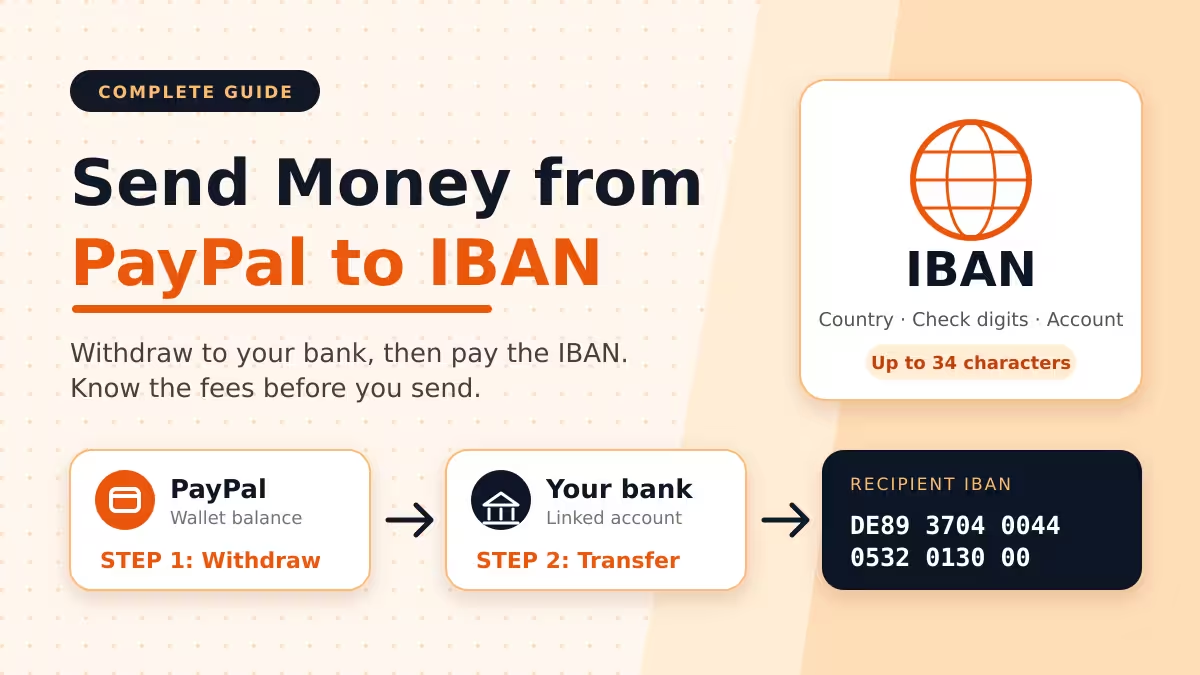
The working route has two legs:
- Withdraw your PayPal balance to a bank account linked to your own PayPal profile.
- Send an international (or SEPA) transfer from that bank to the recipient's IBAN.
Options differ by country, so open your local PayPal app and check the Wallet section before you plan around this. Some regions and business accounts see extra payout features, but you should not count on them.
IBAN Format Explained: What Each Part Means
An International Bank Account Number gives a bank everything it needs to locate one specific account in another country. Every IBAN follows the same pattern:
| Part | What it holds | Example (Germany) |
|---|---|---|
| Country code | Two letters from the ISO standard | DE |
| Check digits | Two numbers that catch typos | 89 |
| BBAN | Bank code, sometimes a branch code, and the account number | 3704 0044 0532 0130 00 |
The full length tops out at 34 characters, and each country fixes its own length. Norway uses 15 characters, Germany uses 22, and France uses 27. If the IBAN you received has the wrong length for its country code, stop and ask the recipient to confirm it.
How to Withdraw PayPal Money to Your Bank Account
Start by getting the funds out of PayPal and into an account that carries your name.
- Sign in to the PayPal website or app.
- Open Wallet and tap Transfer Money.
- Choose Transfer to your bank.
- Pick your linked bank account. If you have none, link one now. PayPal may verify it with two small test deposits, which take a day or two to land.
- Enter the amount.
- Choose standard transfer (free in many countries, takes a few business days) or instant transfer (fast, but PayPal charges a percentage).
- Review the fee and arrival estimate, then confirm.
Match the name and currency on your PayPal account and bank account wherever you can. A mismatch often triggers delays or a returned withdrawal.
How to Pay an IBAN from Your Bank Account
Once the money shows up in your bank balance, collect these details from the recipient:
- Full IBAN
- Account holder name, spelled exactly as the bank has it
- SWIFT/BIC code of the recipient's bank
- Bank name and address (some banks still ask for it)
Then open your bank's app or online banking and follow this flow:
- Find the international payment section. Banks label it Payments, Move Money, or Send Abroad.
- Add a new payee and enter the IBAN, name, and SWIFT/BIC.
- Enter the amount and pick the currency you want the recipient to receive.
- Check the fee, the exchange rate, and the final amount the recipient gets.
- Approve the payment with your OTP, token, or app confirmation.
Most banks validate the IBAN check digits as you type. That check catches typos, but it cannot tell you whether the name matches the account, so verify the name yourself.
If both accounts sit inside the SEPA zone and the transfer is in euros, the bank usually treats it as a cheap or free SEPA transfer that lands within one business day. Transfers outside SEPA, or ones that need a currency conversion, cost more and take longer.
IBAN vs SWIFT/BIC: Which Details Does Your Bank Ask For?
The two codes do different jobs. The IBAN points to one account. The SWIFT/BIC code points to the bank that holds it, and it has 8 or 11 characters.
Here is how that plays out in practice:
- Euro payments inside SEPA: the IBAN alone usually works, because the bank can read the bank identifier inside it.
- Payments outside SEPA or in other currencies: most banks ask for the IBAN and the SWIFT/BIC together.
- Missing or wrong BIC: the bank may hold the payment while it looks the code up, or send it back.
When the recipient gives you only an IBAN and your bank asks for a BIC, search the recipient bank's official website or ask the recipient. Do not guess a code from a third-party list.
Sending to an IBAN from the US, Canada or Australia
Banks in the US, Canada, Australia, and New Zealand do not issue IBANs for domestic accounts. Your own PayPal withdrawal still lands in a regular domestic account, and that is fine. The IBAN only matters on the receiving side.
If you live in one of these countries, expect this:
- You will not have an IBAN of your own, and you do not need one to pay somebody else's.
- Your bank will send the payment as an international wire. It will ask for the recipient's IBAN, the BIC, and the recipient's name and address.
- Wire fees usually run higher than a SEPA transfer, and the bank may add an intermediary charge.
Check the fee schedule in your banking app before you send a large amount.
PayPal to IBAN Fees and Exchange Rate Costs
You can pay charges at three points:
- PayPal currency conversion if you withdraw in a currency different from your balance. PayPal builds a margin into its rate.
- PayPal instant transfer fee if you choose speed over the standard option.
- Bank fees for the outgoing international transfer, plus possible intermediary bank charges that reduce what the recipient receives.
An IBAN itself costs nothing to use. The fees come from the payment providers on the way. Add them up before you send. Two conversions (one at PayPal, one at your bank) can quietly eat a noticeable share of the amount, so convert only once if possible.
5 Mistakes That Make a PayPal to IBAN Transfer Fail
Hunting for a button that does not exist. People waste hours searching the PayPal menus for a direct IBAN option. Plan for the two-step route from the start.
Skipping the bank link. PayPal cannot pay out without a verified bank account in your name. Link it early, because verification takes time.
Entering one wrong character. A single wrong digit in the IBAN or a misspelled name can bounce the payment, and returned transfers often lose money to fees on the way back.
Ignoring the exchange rate. The fee looks small, but the rate margin often costs more. Compare the amount that lands, not the advertised fee.
Using Friends and Family for business payments. If you pay for goods or services, sending through Friends and Family breaks PayPal's User Agreement and can lead to a PayPal limited account.
Note: PayPal's developer portal offers an IBAN generator for sandbox testing. Those numbers exist only for developers testing apps and will never receive real money.
Wise, Remitly and Other PayPal Alternatives for IBAN Transfers
If the PayPal to bank to IBAN route feels slow or expensive, a dedicated money transfer service may serve you better. Wise, Remitly, and WorldRemit specialize in cross-border payments and often show the mid-market exchange rate with a clear fee. Many of them deliver to IBANs within hours.
PayPal still makes sense in a few cases:
- The recipient has a PayPal account, so you can pay them directly without touching an IBAN.
- You already planned to withdraw your PayPal balance to your bank anyway.
- You want PayPal's buyer protection on a purchase, which only applies to payments inside PayPal.
How to Find and Verify an IBAN Before You Send
If you need your own IBAN to receive money, look in your banking app under account details, check a recent bank statement, or ask your branch. To check an IBAN someone sent you, compare its length and format against the official SWIFT IBAN Registry, which lists every participating country.
Sharing your IBAN to receive a payment carries low risk, since nobody can withdraw money with it alone. Still, send it only to people you trust and through a secure channel.
Frequently Asked Questions
Can I send money from PayPal directly to an IBAN?
Not for most personal accounts. You withdraw to your own linked bank first, then send a bank transfer to the IBAN.
How long does the full PayPal to IBAN process take?
Plan for about two to six business days in total. The standard PayPal withdrawal takes one to three days, and the bank transfer adds another one to three, depending on the route and currency.
Do I need a SWIFT code if I have the IBAN?
Within the SEPA zone, the IBAN alone usually works. For transfers outside SEPA, most banks ask for the SWIFT/BIC code as well.
Can I use a US bank account to send money to an IBAN?
Yes. US banks do not issue IBANs, but you can still send an international wire to an IBAN by entering it along with the recipient's SWIFT/BIC code.
Is the PayPal IBAN generator real?
No. It produces test numbers for developers working in the PayPal sandbox. Never use them for real payments.
What happens if I enter a wrong IBAN?
The check digits catch most typos before you submit. If an error slips through, the receiving bank usually rejects the payment and returns it, often minus fees.
Related Guides
- PayPal Permanently Limited Account: How to Get Your Funds Released Before the 180-Day Hold
- Crypto Salary India: Why Freelancers Are Struggling
- How to Use Binance P2P to Sell Crypto and Withdraw Money Safely
- How to Convert $2,500 USDT from Binance Safely in India (Without Getting Your Bank Account Frozen)