D-topia puts you in the role of a Facilitator, the human troubleshooter inside an AI-run utopian community, tasked with keeping residents happy while uncovering what the system hides from them. Marumittu Games developed the puzzle adventure, and Annapurna Interactive published it.
What is D-topia about?
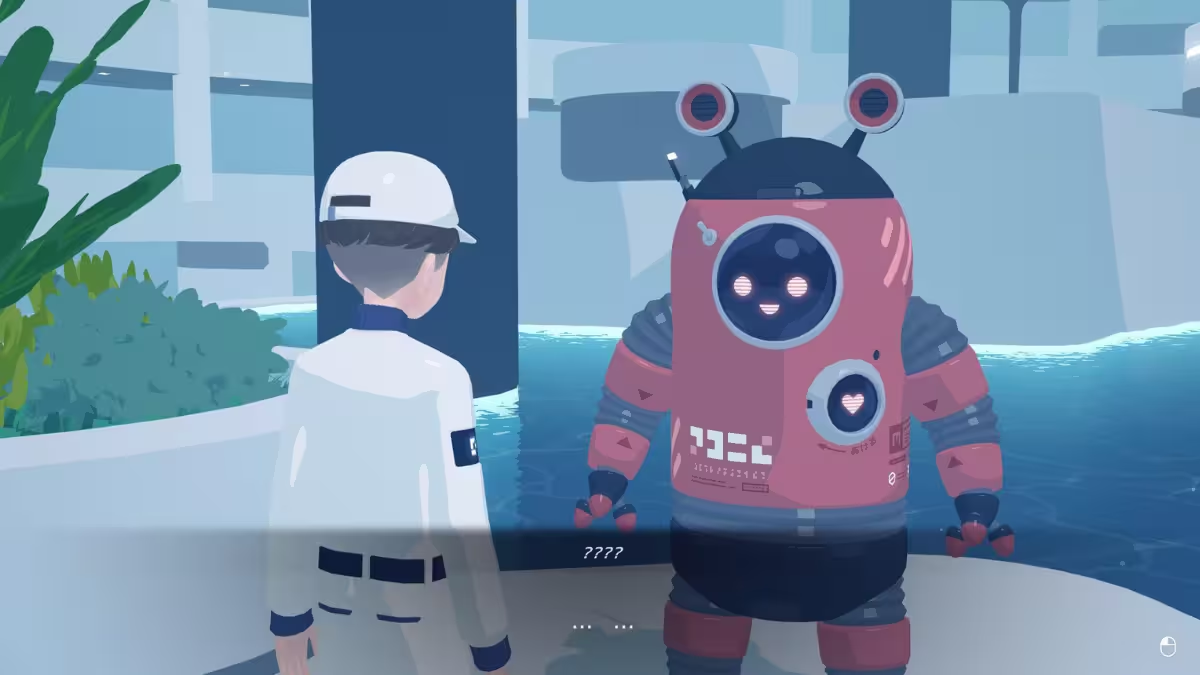
D-topia takes place inside a futuristic residential zone run by an AI system called the Utopia Project, which manages nearly every aspect of residents’ routines in pursuit of maximum happiness and comfort for everyone. You play as a newly assigned Facilitator, identified as No. 046, whose job is to act as the human bridge between the AI’s automated bots, called Troids, and the residents they can’t fully understand or comfort.
The story unfolds over an in-game week. You meet a small cast of residents, and as you get to know them, it becomes clear that D-topia isn’t quite the paradise it appears to be on the outside. You gradually earn their trust through conversation and support, and the choices you make while helping them, including decisions that affect entire characters’ fates, push the story toward one of three endings: bad, neutral, or good.
D-topia platforms and release date
D-topia released on July 14, 2026, and it’s available across a wide range of platforms:
- PC (Steam and Epic Games Store)
- PlayStation 5
- Xbox Series X/S
- Nintendo Switch
- Nintendo Switch 2
D-topia gameplay: puzzles, work shifts, and relationships explained
Each day in D-topia starts with breakfast and a short diagnostic puzzle to confirm you’re ready to begin. From there, your time splits into two main activities: working your shift at the Factory and freely exploring the city to talk with residents.
Factory work involves solving logic-based puzzles that change daily, mostly built around moving numbered blocks across a board while avoiding obstacles. Other puzzle types include a line puzzle where you trace a path through a maze to match a target number, and a Minesweeper-style puzzle built around clearing bugs. None of these puzzles are especially difficult by modern standards, since the game deliberately keeps its challenges light to match its “problem-free utopia” theme. Completing your shift faster earns a better cash grade, and you can also opt into extra “overtime” puzzles for bonus money, or return to unfinished ones later from your apartment’s PC.
Outside of work, you explore zones like the Residential Area, Central Hall, Gardens, and Stockyard, talking to residents and slowly raising a trust meter with each one through conversations and optional check-ins at home. When a resident’s story reaches a difficult decision point, you enter a “Brain Meeting,” a flowchart-style planning screen where you lay out what you know before locking in your choice.
One pacing issue worth knowing about going in: your character’s default walking speed is slow, closer to a light jog, and you need to drink a consumable from city vendors to get a temporary speed boost. Since money from work shifts also goes toward food and home decorations, managing that economy becomes part of the daily loop.
What is the Block Side in D-topia?
Much of what residents experience in D-topia is actually a sensory overlay called the Optimization System. Each zone has a terminal that lets you toggle into the “Block Side,” a colder, more industrial version of the same space that reveals the real machinery running underneath the AI’s curated illusion.
On the Block Side, Troids drop their friendly human-facing personas and often express resentment about their assigned tasks. Everything here looks stripped-down and mechanical compared to the world residents normally see, exposing the machinery the AI keeps hidden from view. This is also where you’ll fix broken equipment, manipulate weather systems, and hack into security systems, usually at a resident’s request, to resolve problems tied to their personal stories. Since only one terminal exists per zone, moving between the public world and the Block Side adds to the game’s overall pacing friction, especially combined with the slow default walking speed.
Collectibles tie into this side of the game too: you can gather decorations for your apartment, and the Block Side hides twenty collectible mice for players who want to fully explore it.
How long does D-topia take to finish?
D-topia runs on a seven-day in-game story and takes roughly 8 to 10 hours to complete, including optional content and side puzzles. There’s no grind and no fail state, so the runtime stays focused rather than padded.
D-topia graphics and performance
The game uses a minimalistic cel-shaded art style that holds up whether you’re viewing the polished public version of D-topia or the sterile Block Side underneath it. Graphics settings are limited to a preset along with basic options like resolution and V-Sync. Thanks to its stylized visuals and linear structure, D-topia runs comfortably on modern hardware. One reviewer clocked a steady 165 FPS running at 1440p with settings maxed out, and reported no notable bugs or performance issues during their playthrough.
Frequently Asked Questions
What platforms is D-topia available on?
D-topia is available on PC via Steam and Epic Games Store, PlayStation 5, Xbox Series X/S, Nintendo Switch, and Nintendo Switch 2.
Who developed and published D-topia?
D-topia was developed by Marumittu Games and published by Annapurna Interactive.
How long does it take to beat D-topia?
Most players can finish D-topia, including optional content, in around 8 to 10 hours.
Does D-topia have multiple endings?
Yes, the game has three possible endings, bad, neutral, and good, determined by the narrative choices you make throughout the story.
Is D-topia combat-focused?
No. D-topia focuses on puzzle-solving, exploration, and story-driven relationship building rather than combat.
Read More
- Aegidron Palworld 1.0: Location, Capture, and Best Build Guide
- Wispaw in Palworld 1.0: Location, Breeding, and Partner Skill Explained
- Woolipop Terra Palworld Location: How to Get Caramel Cotton Candy
- Palworld 1.0 Mutation Pals: How to Get Mutation Eggs and All Passive Skills
- Catch a Brainrot Tier List: Best Moves for PVP and PVE Ranked
- Palworld 1.0 New Passive Skills: Full List, Effects, and Best Picks

