Weak passwords still cause a large share of ransomware attacks, account takeovers, and data breaches. Active Directory includes basic password policy settings, but most organizations now need stronger protection against modern threats like password spraying, credential stuffing, and reuse of leaked passwords.
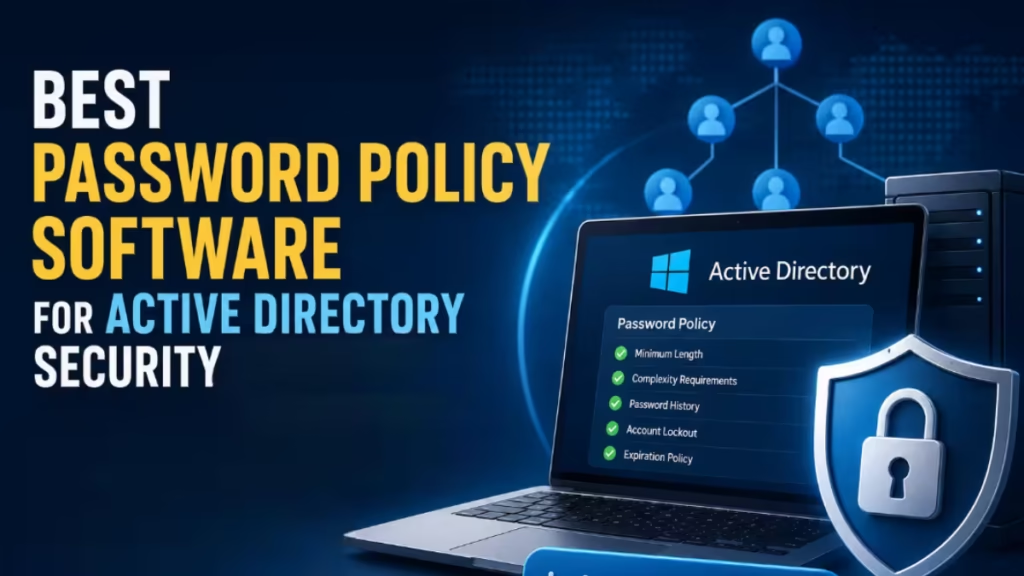
That gap is why many IT administrators run advanced password policy tools alongside Active Directory. These tools block weak passwords, stop compromised credentials, support compliance, and lower risk without frustrating employees. This guide covers the best password policy software for Active Directory security in 2026.
Why Native Active Directory Password Policies Are Not Enough
The default password settings in Active Directory enforce a handful of controls:
- Minimum password length
- Password complexity
- Password expiration
- Account lockout thresholds
These rules stop some bad passwords, but they miss the ones attackers actually use. Native Active Directory cannot block credentials leaked in past breaches, and it cannot detect predictable patterns.
Passwords like these often pass complexity checks while staying trivial to guess:
- Summer2026!
- Welcome123
- CompanyName@1
Advanced password policy tools close that gap by screening every password against breach data and custom dictionaries.
1. Specops Password Policy
Best Overall for Breach Protection
Specops Password Policy is one of the most widely deployed Active Directory password security tools in enterprises worldwide. It extends Group Policy, so administrators manage everything from inside the familiar AD environment.
Its strongest feature is Breached Password Protection. The service screens passwords against a database that now holds more than 5.5 billion compromised credentials, updated daily from real attack data and infostealer logs. Specops Software is owned by Outpost24, whose threat intelligence team supplies that data.
Key Features
- Continuous scanning for breached passwords in Active Directory
- Custom password dictionaries
- Fine-grained policies down to OU and group level
- Real-time feedback during password creation
- Passphrase support with length-based expiration
- Compliance templates
Why It Stands Out
Specops stops users from picking predictable passwords that attackers rely on during spraying campaigns. Instead of a generic Windows rejection, users see clear guidance on why a password failed, which cuts help desk calls.
Best For
- Large enterprises
- Hybrid Active Directory environments
- Organizations with strict compliance requirements
2. Microsoft Entra Password Protection
Best Microsoft-Native Option
Microsoft Entra Password Protection suits businesses already running hybrid Active Directory with Microsoft 365. It extends the same banned password checks Microsoft uses in the cloud into on-premises domain controllers.
One point to set straight: Entra Password Protection does not check passwords against a multi-billion breach database. Its global banned list is intentionally small and built from Microsoft security telemetry on active password spray attacks, then applied with fuzzy matching to catch variants. You add organization-specific terms through a custom banned list.
Key Features
- Blocks common weak passwords and their variants
- Custom banned password list
- On-premises support through a proxy service and DC agents
- No direct internet access required on domain controllers
- No AD schema changes
- Native fit for Microsoft 365 tenants
Why Many Companies Use It
Teams already inside the Microsoft ecosystem prefer it because it needs no third-party software and reuses existing infrastructure. On-premises enforcement requires Microsoft Entra ID P1 or P2 licensing for synchronized users.
Best For
- Microsoft 365 organizations
- Hybrid AD environments
- Teams wanting native Microsoft tooling
3. ManageEngine ADSelfService Plus
Best for Self-Service and Help Desk Relief
ManageEngine ADSelfService Plus pairs password policy enforcement with self-service password reset. That combination reduces help desk tickets while raising password security.
Key Features
- Granular password complexity rules per OU or domain
- Password history and dictionary restrictions
- MFA for logins and resets
- Self-service password reset and account unlock
- Password expiration reminders
Why Businesses Like It
Employees reset forgotten passwords on their own without calling IT, which saves time on both sides. Administrators still apply strict policies that block dictionary words, palindromes, and predictable patterns.
Best For
- Small and medium businesses
- Organizations cutting help desk workload
- Companies that need self-service resets
4. Netwrix Password Policy Enforcer
Best for Compliance and Granular Control
Netwrix Password Policy Enforcer focuses on compliance depth and detailed customization. It supports up to 256 distinct policies with more than 20 rules each, far beyond what native AD offers.
It enforces rules required by major frameworks through out-of-the-box templates:
- CIS benchmarks
- HIPAA
- NERC CIP
- NIST 800-63B
- PCI DSS
Key Features
- Breach database checks across hundreds of millions of leaked hashes in milliseconds
- Dictionary and password similarity detection
- Up to 256 policies with granular rule control
- Partial compliance and length-based expiration to ease adoption
- Customizable rejection messages in 31 languages
- Detailed auditing
Why It Is Popular
Security-focused and regulated organizations choose Netwrix for its policy depth and compliance reporting. The trade-off is that the customization options add complexity in smaller environments.
Best For
- Compliance-heavy industries
- Financial organizations
- Healthcare companies
What Makes a Strong Active Directory Password Policy?
Software helps, but solid policy design carries equal weight.
Favor Length Over Complexity
Long passwords beat short complex ones. NIST guidance now leans toward length and passphrases, and many organizations enforce a minimum of 14 to 16 characters.
- Better: MyDogLovesMorningWalks
- Worse: P@ssw0rd123
Block Breached Passwords
Users reuse credentials exposed in old breaches. Password policy tools block those compromised passwords automatically before they reach production.
Enable Multi-Factor Authentication
MFA adds a second layer that holds even after a password leaks.
Separate Admin Account Policies
Administrator accounts need stricter rules than standard user accounts.
Monitor Failed Logins
A spike in failed logins often signals brute-force or password spraying attempts, so alerting on it shortens response time.
Which Password Policy Tool Should You Choose?
The right choice depends on your size, stack, and compliance needs.
| Requirement | Recommended Tool |
|---|---|
| Best breach protection | Specops Password Policy |
| Best Microsoft integration | Microsoft Entra Password Protection |
| Best self-service features | ManageEngine ADSelfService Plus |
| Best compliance controls | Netwrix Password Policy Enforcer |
Frequently Asked Questions
Does Active Directory have built-in password policy software?
Active Directory enforces length, complexity, expiration, and lockout through Group Policy and fine-grained password policies. It does not block breached passwords or detect weak patterns, so most organizations add a third-party tool.
What is the best password policy software for Active Directory?
For breach protection, Specops Password Policy leads with its continuously updated database of over 5.5 billion compromised credentials. Microsoft Entra Password Protection fits Microsoft 365 shops, and Netwrix Password Policy Enforcer suits compliance-heavy environments.
Can Active Directory block leaked or breached passwords?
Native Active Directory cannot block breached passwords on its own. Tools like Specops and Netwrix screen new passwords against breach databases and reject any match during the password change.
Is Microsoft Entra Password Protection free?
The cloud-only banned password protection is included with Microsoft Entra ID. On-premises enforcement for Windows Server Active Directory requires Microsoft Entra ID P1 or P2 licensing for synchronized users.
What password length does NIST recommend?
NIST 800-63B requires a minimum of 8 characters and supports much longer passphrases. Many security teams set a higher floor of 14 to 16 characters and prefer passphrases over f
Attackers keep targeting weak passwords because they remain one of the easiest ways into a network. Default Active Directory settings no longer meet that threat on their own.
Advanced password policy tools block weak and breached credentials, support compliance, and cut risk without piling friction onto users. Specops Password Policy is the strongest all-around pick for breach protection, while Microsoft-focused teams often prefer Entra Password Protection for its native fit. Match the tool to your size, stack, and compliance needs, and your Active Directory security improves immediately.

