AI writing tools now produce text that reads smoothly enough to fool most readers. Editors want to know what freelancers submit, teachers want to know what students hand in, and writers want to know whether their own clean prose looks suspicious to a scanner. AI detectors try to answer that question, but they differ a lot in accuracy, price and purpose.
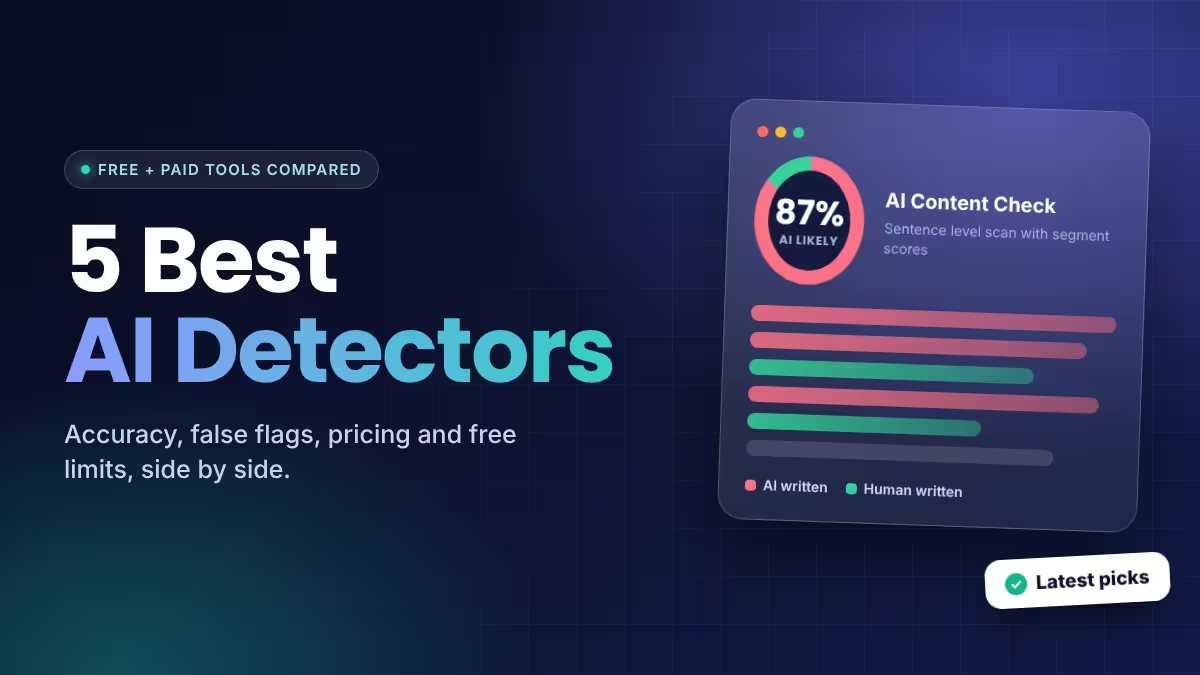
This guide covers the five detectors worth your time, who should use each one, and how to avoid the biggest mistake people make with them.
Quick Picks: One Detector for Each Need
- Fewest false flags: Pangram
- Bulk checks for publishers: Originality.ai
- Free check for classrooms: GPTZero
- Many languages and compliance: Copyleaks
- Shareable reports and scanned pages: Winston AI
How AI Detectors Spot Machine Writing
A detector does not find a hidden fingerprint. It estimates how likely a language model is to have produced a passage. Two signals drive most scores.
Perplexity tracks how predictable each word is. Models favor likely words, so machine text tends to look smooth and even. Burstiness tracks how much sentence length and structure change. People mix short and long sentences. Models often keep a steadier rhythm.
This design explains the weak spots too. A detector struggles with heavily edited text, with output from models it has not seen, and with human writing that happens to be predictable, such as formulaic technical prose or simple vocabulary from a non-native English writer. Treat every score as a probability, never as proof.
1. Pangram: Most Reliable AI Detector With the Fewest False Flags
Pangram focuses on the problem that hurts most: wrongly flagging a real person. Independent academic testing found it was the only detector that kept false positives at or below 0.5% while still catching AI text reliably. In a peer-reviewed study of academic papers, it gave fully AI-written papers an average AI score of 85.7%. Three well-known rivals scored 14.3% or lower on the same papers.
The newer versions of the tool score text segment by segment and sort it into tiers, so you can tell light AI assistance from full generation. That nuance helps when a draft mixes human and machine writing. Pangram also covers more than 20 languages and plugs into a Chrome extension, Google Docs and major learning management systems.
Pricing: The free plan covers 2,000 words per day. The Individual plan costs $20 per month, and the Professional plan costs $65 per month with API credit.
Limitations: No built-in plagiarism check, and the free daily cap limits heavy use.
Best for: Teachers, editors and anyone who cannot afford a wrong accusation.
2. Originality.ai: Best AI Checker for Publishers and SEO Teams
Originality.ai suits people who vet content in bulk. It combines AI detection, plagiarism scanning, fact-checking and readability checks in one workflow. Agencies like its team dashboards, bulk scanning, API and full-site scan, which lets you audit an entire website for AI-heavy pages.
It also handles rewritten text better than most rivals. In a public benchmark it caught 96.7% of paraphrased AI text, the strongest result in that test. The same benchmark showed a weakness: tricks like invisible characters and look-alike letters pushed its accuracy below 10%.
Pricing: The Pro plan starts at $14.95 per month for 2,000 credits. Pay-as-you-go costs $30 for 3,000 credits, and the Enterprise plan costs $179 per month. You get only a few signup credits for free.
Limitations: No real free tier. Also remember that Google ranks content on quality, not on who or what wrote it. Use this tool to enforce your editorial standard, not to chase a ranking penalty that does not exist.
Best for: Content agencies, blog networks and editors who review freelancer work.
3. GPTZero: Best Free AI Detector for Teachers and Students
GPTZero started as a classroom tool and still behaves like one. The basic checker works without an account, so students and teachers can paste text and get a result in seconds. It highlights suspicious sentences, connects with Canvas, Google Classroom and Moodle, and offers an API for institutions.
Its Writing Replay feature stands out. Students can show how a document grew over time, which gives a teacher process evidence instead of a bare percentage. A Paraphraser Shield mode also targets text that someone has run through a rewriting tool.
Independent results look mixed. In the academic-paper study mentioned above, GPTZero correctly cleared every human paper but gave fully AI-written papers an average score of just 14.3%. The company itself says its results should not be used to punish students, and that advice deserves attention.
Pricing: The basic checker is free. Premium plans give 300,000 words per month, and Professional plans give 500,000. Prices change by region, so check the live pricing page.
Limitations: Weaker detection of fully AI-written long documents in recent independent testing.
Best for: Teachers and students who want a free first-pass check with classroom integrations.
4. Copyleaks: Best AI Detector for Multiple Languages and Compliance
Copyleaks pairs AI detection with a mature plagiarism engine. It supports more than 30 languages, holds SOC 2 compliance, and offers API access, which makes procurement teams comfortable. It can also flag AI-generated source code, a rare feature among detectors.
The free option lets you scan up to 25,000 characters without creating an account. A free account adds monthly credits. Paid plans start around $10 per month on annual billing.
Be realistic about accuracy. Copyleaks avoided false accusations in recent academic testing, but it labeled none of the fully AI-written papers as AI. It caught 30% of hybrid papers and 22.5% of humanized ones. Scans can also run slowly, sometimes close to a minute for a short passage.
Limitations: Missed detections on heavily edited text, and an interface built for organizations more than individuals.
Best for: Global teams that need plagiarism checks, AI checks and compliance paperwork in one platform.
5. Winston AI: Best AI Detector for PDF Reports and Scanned Pages
Winston AI shines when you need to document a result. It produces shareable PDF reports, shows a human score with sentence-level highlighting, and reads scanned pages and handwriting through OCR. It also includes plagiarism checks and AI-image detection, and it connects with Google Classroom and WordPress.
New users get a limited free trial of about 2,000 words over 14 days. The tool needs at least 500 characters to run a scan.
The company advertises accuracy above 99%, but it ran that test itself. Its only peer-reviewed result dates from 2023 and landed mid-table. Use it for its reporting strength and double-check every flag.
Limitations: The free trial is small, and the headline accuracy figure comes from the company's own test.
Best for: Publishers, schools and agencies that need clean, shareable evidence of each scan.
Which AI Detector Fits Your Job?
Match the tool to the job instead of chasing the highest advertised number.
- Choose Pangram when a wrong flag could hurt someone's grade, job or reputation.
- Choose Originality.ai when you screen large volumes of freelancer copy.
- Choose GPTZero when you want a free, no-signup check or classroom integrations.
- Choose Copyleaks when you need many languages and compliance documents.
- Choose Winston AI when you need polished reports and OCR.
Vendors usually claim 99% accuracy, and those numbers come from clean, unedited AI text. Independent tests on edited, mixed or rewritten text show far lower results, often between 60% and 90%. Expect your real-world results to land between the two figures.
Are Free AI Detectors Good Enough?
For occasional checks, yes. Pangram gives 2,000 free words per day, GPTZero offers a basic checker with no account, and Copyleaks scans up to 25,000 characters without signup. These free options give you a useful signal on a single article or essay.
Free tools hit limits fast. They cap your volume, drop some features such as detailed reports and bulk scanning, and lose accuracy on text that someone has edited or rewritten. They also may keep the text you paste. If you check dozens of pieces a week or handle confidential drafts, a paid plan makes more sense, and the same applies to AI tools for small business teams that build a full content stack.
What You Will Pay for Each AI Detector
- Pangram: Free for 2,000 words per day. Individual costs $20 per month, and Professional costs $65 per month.
- Originality.ai: Pro costs $14.95 per month for 2,000 credits. Pay-as-you-go costs $30 for 3,000 credits, and Enterprise costs $179 per month.
- GPTZero: Free basic checker. Premium gives 300,000 words per month and Professional gives 500,000, with prices shown in your local currency.
- Copyleaks: Free scans up to 25,000 characters. Paid plans start around $10 per month on annual billing.
- Winston AI: A 14-day free trial. Paid plans cost $18, $29 and $49 per month for 100,000, 200,000 and 500,000 credits.
Do not pay for enterprise pricing if you still have to verify every flag by hand. For most individuals and classrooms, a free tier covers the need.
Can You Trust an AI Detector Score?
Use the score as a lead, not a verdict. These habits keep you out of trouble:
- Scan at least 150 to 200 words. Short passages give unreliable scores.
- Run important text through two detectors. When both flag it, your confidence rises. When they disagree, treat the result as inconclusive.
- Keep drafts, notes and version history. Process evidence persuades far more than a second scanner does.
- Never let a single percentage decide anything about a person. Scale shows the risk: at a 10% false-positive rate, a teacher who checks 300 essays wrongly flags about 30 honest students.
- Check your own writing before you submit it. Clean, formulaic prose and non-native English sometimes trigger flags, and knowing your risk early protects you from false AI accusations.
- Read the privacy policy before you paste confidential text.
Remember that rewriting tools, often called humanizers, can defeat most detectors after a few passes. A "human" result therefore proves little on its own, and a flag proves little too.
Frequently Asked Questions
What is the best AI detector overall?
Pangram has the strongest independent evidence for accuracy with the fewest false positives. Originality.ai leads for edited and paraphrased publishing copy.
Is there a good free AI detector?
Yes. Pangram's free plan gives 2,000 words per day, and GPTZero offers a basic checker with no account. Copyleaks also scans up to 25,000 characters for free. All free tools lose accuracy on edited or rewritten text.
Can AI detectors flag human writing by mistake?
Yes. Formal academic writing, formulaic technical text and writing by non-native English speakers can look predictable to a detector. Older studies found high error rates for non-native writers, while newer testing found fewer problems, but the risk has not vanished.
Can detectors spot text from ChatGPT, Claude and Gemini?
The better tools detect output from all three. Single-model tools often drop sharply on text from models they did not train on. Mixed human and AI text is the hardest case for every detector.
Does Google penalize AI-written content?
Google says it judges content on quality and usefulness, not on how someone produced it. Use a detector to enforce your own editorial standards rather than to avoid a penalty.
Can I rely on one detector to prove a text came from AI?
No. A detector gives a probability, not a verdict. Combine the score with human review and process evidence such as drafts and revision history.