Microsoft is quietly expanding personalization inside Copilot with a new personality selector that lets users choose how the AI responds. According to Testing Catalog, Microsoft has started rolling out the feature as part of an internal experiment called Personality Studio, allowing users to select different response styles inside the Copilot chat interface.
The update signals Microsoft’s growing focus on making Copilot more adaptive and competitive as AI assistants increasingly compete on customization and user control.
Copilot Begins Testing a Personality Selector
The personality selector appears directly inside the Copilot chat interface and allows users to adjust how the assistant communicates. Users can switch between response styles designed for faster answers, clearer explanations, or more structured replies.
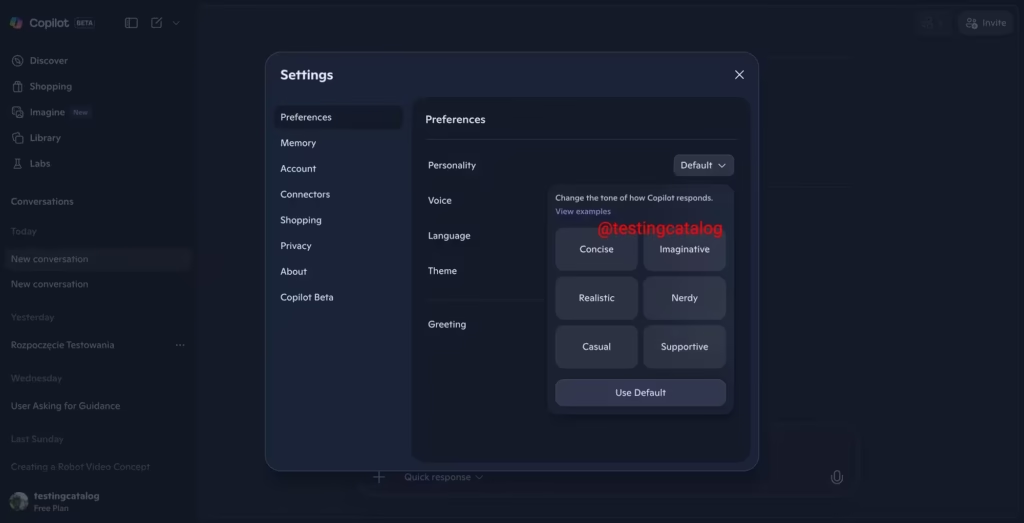
At this stage, Microsoft limits access to only a small set of default options. Most users currently see only the standard or concise style. This phased rollout mirrors how Microsoft typically introduces new Copilot features, especially those that affect core user experience and system behavior.
Memory Controls Move Into a Unified Settings Area
Microsoft has also updated how users manage Copilot’s memory and personalization settings. The company now groups memory controls alongside other preferences, making it easier for users to control how Copilot stores context, remembers preferences, and manages session behavior.
This change improves transparency and gives users clearer visibility into how the assistant adapts to individual workflows. It also reduces friction for users who want tighter control over personalization without navigating multiple settings pages.
Early Signals Point to Reminders and Video Features
Ongoing internal testing shows references to a dedicated reminders category inside Copilot. This addition could strengthen task tracking, follow-ups, and productivity workflows across Microsoft’s ecosystem.
See also: Microsoft Copilot AI Video Feature and Real Talk Mode Enter Testing as AI Competition Heats Up
Engineers have also detected traces of potential video generation support. While Microsoft has not confirmed timelines or availability, these signals suggest that Copilot may expand beyond text-only assistance into more creative and multimedia capabilities over time.
GPT 5.2 Access Remains Limited
Despite new interface features, many Copilot users still operate on GPT 5.1. Only a small group currently has access to GPT 5.2, and Microsoft has not explained when broader access will arrive.
Microsoft has also acknowledged that its internal teams now use Claude Code alongside Copilot during development. This move reflects a multi-tool AI strategy rather than exclusive reliance on a single assistant platform.
See also: Microsoft Shares Private BitLocker Recovery Keys With FBI in First Known Case
The approach allows teams to compare outputs, improve reliability, and accelerate experimentation across different AI models. It also signals that Microsoft views AI tooling as a flexible ecosystem rather than a locked-in solution.
As Microsoft expands personality options, strengthens memory management, and explores creative features such as video generation, Copilot could evolve into a more capable assistant across both enterprise and consumer environments. Wider access to GPT 5.2 will likely determine how quickly these improvements translate into real-world performance gains.

