Neverness to Everness throws a lot of currency names at you the moment you load in, and most of them have nothing to do with the gacha system. Between pull currencies, shop currencies, progression materials, and real-money tokens, knowing what each one does is the difference between spending efficiently and accidentally burning premium resources on the wrong banner.
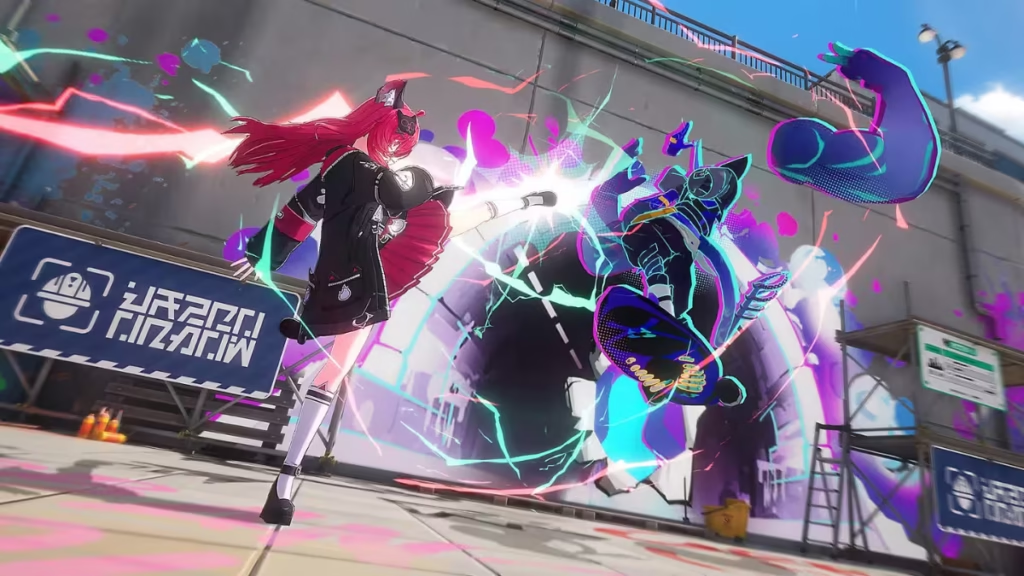
This guide covers every currency in NTE, what it does, how you earn it, and where it fits into the broader economy.
All Neverness to Everness Currencies
| Currency | Type | Primary Use |
|---|---|---|
| Annulith | Premium (free/paid) | Converts to pull currencies at 160 per pull |
| Riftcrystal | Paid only | Converts to Annulith at 1:1 |
| Solid Dice | Limited Banner pull | Rolling on the current featured character banner |
| Fabricated Dice | Standard Banner pull | Rolling on the permanent character banner |
| Tri-Keys | Weapon currency | Arc Research Program and S-Rank Arc purchases |
| Beetle Coins | Progression currency | General shops, materials, Tycoon upgrades |
| Fons | In-world currency | Endgame upgrades, properties, vehicles, crafting |
| Warp Pieces | Gacha byproduct | Fair Shop for pulls or standard characters |
| Lost Pieces | Gacha byproduct | Lost Piece Shop for upgrade materials and monthly pulls |
| Carrotas | Module currency | Console Module upgrades via the Rewind feature |
| Elite Hunter Guides | Progression material | Leveling and advancing characters |
Annulith
Annulith is the main premium currency in Neverness to Everness and the one you will track most closely as a free-to-play player. You earn it through quests, events, exploration, achievements, daily activities, and login rewards. The game front-loads Annulith heavily, especially in the early campaign, so the supply feels generous at first before settling into a slower drip in the endgame.
The exchange rate is 160 Annulith per pull. Depending on which banner you want to target, you convert Annulith into Solid Dice, Fabricated Dice, or Tri-Keys. Annulith itself does not directly pull anything. You always convert it first.
F2P players should treat Annulith as a resource to save rather than spend on impulse. If you add and invite friends in NTE, some social and co-op activities also reward small amounts of Annulith over time.
Riftcrystal
Riftcrystal is the paid premium currency. You cannot earn it through gameplay. The only source is purchasing it with real money through top-up packages, which range from roughly $0.93 to $80.60 USD.
Riftcrystals convert into Annulith at a 1:1 ratio, which is the standard model across most gacha titles. You can also spend them directly in the Mall on cosmetics. If you are going fully free-to-play, your Riftcrystal balance stays at zero, and that has no effect on your ability to pull characters or progress.
Solid Dice
Solid Dice are the pull currency for the Limited Board, the banner that features a rotating time-limited S-Class character. Each Solid Die equals one roll. You spend 160 Annulith to convert into one Solid Die, and events and login rewards occasionally hand them out directly.
The most important thing to know about the Limited Board is that NTE eliminates the 50/50 mechanic entirely. When you hit pity, you are guaranteed the featured character with no coin flip against standard characters. Every pity you build on the Limited Board pays out the character you actually want.
Save Solid Dice exclusively for Limited Banners featuring characters you have decided to pull. Spending them on any other banner type locks them out of their best use case.
Fabricated Dice
Fabricated Dice are the pull currency for the Standard Board, the permanent banner that holds the full pool of standard S-Class and A-Class characters. Each Fabricated Die equals one roll, and like Solid Dice, each costs 160 Annulith to purchase.
The Standard Board has two player-friendly mechanics worth knowing. First, the initial 10 pulls receive a 20% discount. Second, after 50 pulls, the board gives you a free S-Rank Selector, letting you choose one of six available standard S-Class characters with no extra spending required. That selector alone makes the Standard Board worthwhile for newer players who have not yet built out their roster.
Since the Standard Banner does not rotate, you can spend Fabricated Dice whenever it suits your schedule without worrying about a banner deadline.
Tri-Keys
Tri-Keys are the weapon currency in NTE, and they represent one of the game’s most praised design decisions. Unlike most gacha titles that lock top-tier weapons behind a separate real-money banner, Neverness to Everness makes all S-Class Arcs obtainable through direct purchase with Tri-Keys. There is no weapon gacha.
You earn Tri-Keys through events, exchange shops, and Annulith conversion. The Arc Research Program offers a gacha-style 10-pull system with pity (guaranteed S-Rank Arc at 60 pulls, signature weapon within 80 pulls), but you also have the option to skip the random element entirely and buy specific S-Rank Arcs directly at 25 Tri-Keys each.
The game awards 25 guaranteed Tri-Keys through the Anomaly Hunter’s Journey milestone rewards up to Hunter Level 40, giving you a free S-Rank Arc or a couple of Arc banner pulls before you need to earn more.
For a closer look at what Arcs you can secure without spending premium currency, check the full list of free S-Rank Arcs in NTE. If you play Esper Zero, the Day Off Arc is one of the strongest free weapons available and worth picking up early.
Beetle Coins
Beetle Coins are the general-purpose free currency that circulates through daily life in Hethereau. They are not a pull currency. Commissions, events, daily activities, and Battle Pass rewards all generate Beetle Coins steadily, and they cover purchases at most vendors and shops throughout the city.
The economy around Beetle Coins is designed around high volume. Players burn through tens of thousands quickly in the early-to-mid game when squad investment is at its peak. Spending frugally on your core team first prevents you from running dry when it matters most.
Once you hit Hunter Level 60 and cap out your XP gain, the game converts excess XP into Beetle Coins, giving you a passive income stream at the endgame ceiling.
Fons
Fons serve two purposes in NTE, and both matter. Inside the City Tycoon system, Fons fund property purchases, vehicle acquisitions, furniture, and business investments. In the broader gaming progression system, Fons power endgame character and gear upgrades, which carry significant costs.
The main Fons sources in the endgame are Circle Bounty (an activity where you track and eliminate targets tied to The Circle organization), Riftcrystal Mining Permits, and Anomaly Commissions. The Pink Paws Heist activity offers up to one million Fons per two-week cycle and provides the fastest burst income available.
Beta feedback flagged that Fons earn rates from Circle Bounty and Mining Permits were too low relative to endgame upgrade costs. The developers acknowledged this and confirmed improved Fon rates for the official launch, so the early economy should be less punishing than the beta suggested.
Avoid unnecessary Fon spending in the early game. Daily income from commissions and Circle Bounty adds up over time, but the gap between what you earn and what endgame upgrades demand is real.
Warp Pieces and Lost Pieces
Both currencies are passive byproducts of using the Scarborough Fair banner system. You do not need to do anything special to earn them. They accumulate automatically as you pull.
Warp Pieces drop from Hero Chest tiles, Warp Chess Box tiles, and Slumberland captures on the Fair board. Pulling a duplicate character also converts into Warp Pieces. You spend them in the Fair Shop on additional pulls or copies of standard banner characters, making them function similarly to Starglitter in Genshin Impact.
Lost Pieces come from Lost Chess Box tiles on the Fair board. The Lost Piece Shop refreshes monthly and offers upgrade materials alongside a limited number of monthly pull allowances. Both shops provide a predictable supplemental income stream from your regular pulling activity.
Carrotas
Carrotas come in three rarities: Bronze, Silver, and Gold. They are not pull currencies and have nothing to do with the gacha system. Their sole purpose is funding Console Module upgrades through the Rewind feature, which you access either from the Console tab on a character’s page or through the Console section of the Exploration Guide.
Modules carry random stats, so chasing the ideal Module for each character requires multiple Carrotas across different upgrade attempts. The Rabbit Hole Anomaly Zone is the primary source for Carrotas and also the location where you unlock new Cartridges for your Consoles, making it a one-stop shop for Console progression.
Gold Carrotas unlock as you advance deeper into the game and gain access to higher-tier Modules.
Elite Hunter Guides
Elite Hunter Guides are character progression materials, not currencies in the traditional sense. They function as experience items consumed directly to level up characters. You earn them through gameplay activities, events, and milestone rewards.
The pre-registration milestone at 20 million players rewarded 20 Elite Hunter Guides to all players, representing roughly one character push through multiple level brackets. Unlike currencies that sit in your wallet until you choose to spend them, Elite Hunter Guides are consumed immediately on use and do not carry over into other systems.
Tips for Managing Your Currencies
- Save Solid Dice for Limited Banners: The guaranteed featured character at pity with no 50/50 means every die you spend on the Limited Board is working toward a character you actually want.
- Spend Fabricated Dice freely on the Standard Banner: The S-Rank Selector at 50 pulls makes the permanent banner a strong early-game investment, especially for players who need roster depth before pushing harder content.
- Prioritize Tri-Keys toward your main DPS Arc: The 25 Tri-Key direct purchase option removes all randomness from weapon acquisition. Identify the best Arc for your core character and work toward it directly rather than rolling the Arc banner blind.
- Do not neglect Fon-earning activities: Endgame upgrade costs are steep, and the daily income from Circle Bounty and Anomaly Commissions is the most reliable way to stay ahead of the curve.
- Check the Fair Shop and Lost Piece Shop monthly: Warp Pieces and Lost Pieces accumulate passively through regular pulling. Both shops reset each month, so missing a cycle means leaving upgrade materials on the table.
Mastering the currency system makes the rest of NTE click into place. Sharp spending decisions across all three economy tracks (gacha, weapon, and progression) compound into real advantages, especially as you push into harder combat content in the endgame. Play Now!

