Agentic pentesting puts an AI agent in the attacker’s seat. You give the agent a target and a goal, and it decides which steps to take, runs the tools, reads the results, and adjusts until it either breaks in or runs out of options. Security teams adopt it because attackers now move faster than any manual testing schedule can follow.
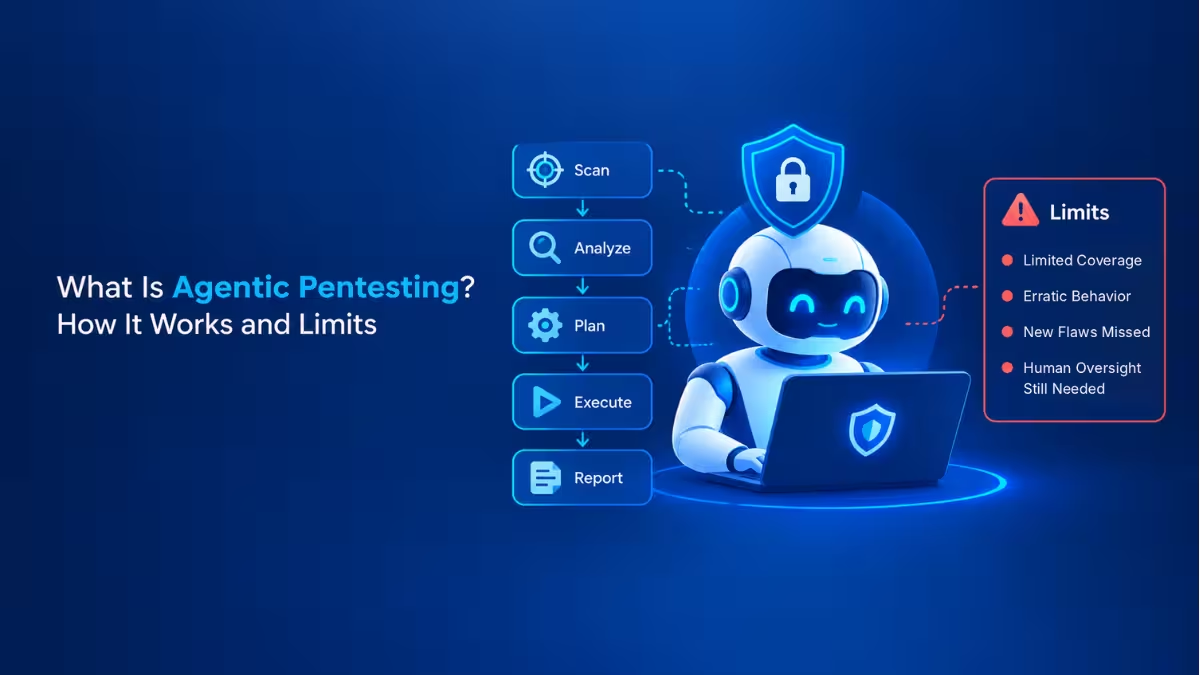
What Is Agentic Pentesting? (AI Pentesting Agents Explained)
Agentic pentesting is penetration testing driven by an autonomous AI agent that reasons about a target instead of following a fixed script.
A traditional scanner matches signatures and version numbers against a database. An agentic system behaves more like a junior ethical hacker. It forms a hypothesis (“this endpoint may leak user IDs”), tests it, studies the response, and chooses the next move. A large language model (LLM) supplies the reasoning, and real security tools supply the actions.
The result is a finding backed by evidence. The agent does not say a server might be vulnerable. It shows the request it sent, the response it got, and the access it gained.
How Does Agentic Pentesting Work?
An agentic pentester runs on four working parts that repeat in a loop until the goal is met or the scope ends.
- Reasoning engine: Breaks a broad goal such as “reach the customer database” into smaller tasks.
- Memory: Stores what the agent has already found, so it does not repeat failed attempts and can build on earlier access.
- Tool use: Calls established tools like Nmap and Metasploit, and writes custom scripts when no tool fits.
- Reflection: Reads errors and unexpected output, then changes the approach.
A typical run starts with reconnaissance and asset discovery. The agent then tests individual weaknesses, confirms the ones that work, and links them into a path toward a valuable asset, such as an admin panel or a database.
Agentic Pentesting vs Traditional Pentesting vs Vulnerability Scanning
Agentic pentesting sits between a scanner and a human tester. Each method answers a different question, so most mature programs use more than one.
| Method | Main question | Strength | Weakness |
|---|---|---|---|
| Vulnerability scan | What known flaws might exist? | Cheap, fast, broad | Reports possibilities, not proof |
| Human-led pentest | Can a skilled attacker get in? | Creativity, business context | Slow, costly, point in time |
| Agentic pentest | Can this exact path be exploited right now? | Machine speed, proof, repeatable | Limited judgment, safety risk in live systems |
Cost shows the gap clearly. SecurityMetrics puts a typical human-led penetration test at roughly $15,000 to $30,000 and says any “pentest” priced under $4,000 probably is not a real one. Agentic tools aim to bring repeatable testing within reach of teams that cannot buy a manual engagement every quarter.
Benefits of Agentic Pentesting for Continuous Security Testing
Attackers exploit new flaws faster than annual or quarterly tests can catch them.
Several 2026 figures show the pressure:
- Security researchers tracked 35,364 new CVEs (Common Vulnerabilities and Exposures, the public IDs for known software flaws) in the first half of 2026, up 49.5% from the same period in 2025.
- Only a small fraction of published CVEs ever see exploitation in the wild, so severity scores alone send teams after the wrong fixes.
- The Zero Day Clock project reports that the average time from disclosure to exploitation fell from 21.5 days in 2025 to about 8 hours in 2026.
A yearly pentest leaves up to 365 days between a change and the next test. Gartner’s Continuous Offensive Security Testing model responds to this with testing that a change triggers, instead of a calendar. The question shifts from “did we test this year?” to “how fast do we validate a new exposure?”
Note that several of these numbers come from vendors who sell validation products, so treat them as directional rather than precise.
What Can AI Pentesting Agents Do? Exploit Chaining and Retesting
Speed only helps when the result is trustworthy, and agentic pentesting proves two things better than most other methods: that a single weakness is exploitable, and that several weaknesses chain into a real attack path.
Consider a low-severity cross-site scripting (XSS) bug. A scanner flags it and moves on. An agent can use it to steal an administrator session token, call a restricted API with that token, find a server-side request forgery (SSRF) flaw behind the API, and pull internal credentials. Each step looks minor alone. Together they reach the crown jewels.
Retesting adds a further benefit. After a developer ships a fix, the agent replays the exact exploit chain and confirms the path is closed. Teams close tickets on evidence instead of hope.
Limitations and Risks of Agentic Pentesting
Agentic pentesting cannot cover everything, and the gaps matter as much as the strengths.
- Coverage: Live exploitation stays out of business-critical production systems, very large network segments, and air-gapped zones for safety and access reasons. One vendor estimates that exploit-driven testing alone sees only 20 to 30% of real exploitability in a typical enterprise. That figure comes from a company selling a broader validation platform, so verify it against your own environment.
- Speed at scale: Careful step-by-step testing across hundreds of thousands of endpoints can take weeks. Results from the start of a sweep may describe systems that have since changed.
- Unpredictable behavior: LLMs hallucinate and drift. A misread exploit script can flood a database, corrupt production data, or write sensitive records into unprotected logs.
- Novel flaws: Agents apply known CVEs and attack patterns well. They struggle with bespoke business-logic bugs and true zero-days that need human intuition.
- Social engineering: An agent can draft convincing phishing text, but it cannot improvise a phone call to a help desk or talk past a security guard.
- Token cost: Reflection loops burn through API calls. A single deep engagement can consume millions of tokens, and costs climb with network size.
Two other methods cover the systems where live exploits cannot go, which closes part of that coverage gap. Exploitability validation tests the attacker techniques a vulnerability needs without firing a working exploit, and breach and attack simulation checks whether your defenses block, detect, or miss a known campaign. Many teams pair these with agentic pentesting and feed everything into one findings list so duplicate alerts do not pile up.
Will Agentic Pentesting Replace Human Pentesters?
No, because agents and people cover different parts of the job, and the strongest programs use both.
Agents take over repetitive work such as asset discovery, wide scanning, and replaying known attack chains at machine speed. That frees human testers to set the rules of engagement, approve risky payloads, and hunt for flaws that need creativity.
People also supply what agents lack. They judge business context, such as whether an open API is a critical hole or an intentional public directory. They run social engineering and physical tests, and they find the novel zero-days that need lateral thinking. Treat the agent as a force multiplier for your testers, not a substitute.
AI Pentesting Tools: Commercial and Open-Source Options
If you want to try agentic pentesting, the market splits into managed commercial platforms and flexible community frameworks.
Commercial platforms such as Horizon3.ai’s NodeZero and XBOW focus on verified exploitation with very few false positives. XBOW drew attention when it reached the top of the HackerOne leaderboard ahead of human researchers. Synack offers a hybrid model that pairs its Sara AI pentesting with human validation from its Red Team, and it runs a free trial on approved targets until October 31, 2026.
Open-source projects such as Strix, PentestGPT, and PentAGI work as containerized workbenches. They suggest attack vectors, plan tasks, and let teams connect tools through the Model Context Protocol. They give you full code transparency, but they need more hands-on supervision.
OWASP and MITRE ATLAS: Frameworks for Safe Agentic Pentesting
Any tool that acts on live systems needs firm boundaries, and two public frameworks help teams set them.
The OWASP AI Testing Guide covers least-privilege tool access, guardrail testing, and protection against poisoned agent memory. MITRE ATLAS maps tactics against AI systems, including prompt injection and data theft through connected tools. Use ATLAS when the target includes AI features, and use the standard MITRE ATT&CK matrix for conventional infrastructure.
How to Run Your First Agentic Pentest Safely
Start small, stay inside a sandbox, and keep a human in control. The steps below apply those guardrails to a first pilot.
- Pick a bounded scope. Choose a staging service or isolated QA API, not production.
- Set rules of engagement. Prove you own every asset and write down what the agent may and may not touch.
- Allowlist the network. Block the agent from following links or drifting into unapproved ranges.
- Install a kill switch. Make sure you can end every active session and container at once.
- Assign a human supervisor. One engineer approves risky payloads and triages results.
- Run the agent in an ephemeral container. Use Docker or a Kubernetes pod so a bad command cannot reach the wider network.
- Supply clean inputs. Current OpenAPI specs and an accurate asset inventory cut token use and improve accuracy.
- Mask sensitive data. Strip personal data from the agent’s memory and logs to stay within GDPR and HIPAA rules.
Once the pilot works, connect the agent to your CI/CD (build and deployment) pipeline so a new commit or API change triggers a focused test, and route confirmed findings into Jira or GitHub Issues with the exploit path attached.
Frequently Asked Questions
Is agentic pentesting the same as automated pentesting?
No. Automated pentesting usually runs predefined scripts and matches signatures. Agentic pentesting reasons about the target, adapts its plan after each result, and chains separate weaknesses into one attack path.
Is agentic pentesting safe to run in production?
It can be, with strict guardrails. Good platforms pace requests, throttle traffic when latency rises, and use non-destructive payloads. Because LLMs behave unpredictably, many teams start in staging and add deterministic code filters that check each action before it runs.
How does an agent confirm blind vulnerabilities?
Blind flaws, such as blind SQL injection, show nothing in the HTTP response. The agent starts a short-lived listener and sends a payload that forces the target to call back over DNS or HTTP. A received callback proves the flaw.
How does an agent test for data leaks between tenants?
The operator supplies credentials for two separate test accounts. The agent captures object identifiers or tokens from the first tenant and replays them against the second, which exposes broken access controls without risking real customer data.
How much does agentic pentesting cost?
Pricing varies by vendor and scope. Commercial platforms charge subscription or per-engagement fees, and open-source tools cost nothing to license but add LLM token costs and engineering time.
