Many people still believe crypto lets criminals move money without a trace. The opposite holds for most public blockchains. Bitcoin and Ethereum write every transfer into a permanent ledger that anyone can read, and a whole industry now exists to turn that ledger into evidence. Exchanges, banks, police units and compliance teams rely on blockchain analytics every day to follow stolen funds, spot laundering and decide which transfers to block.
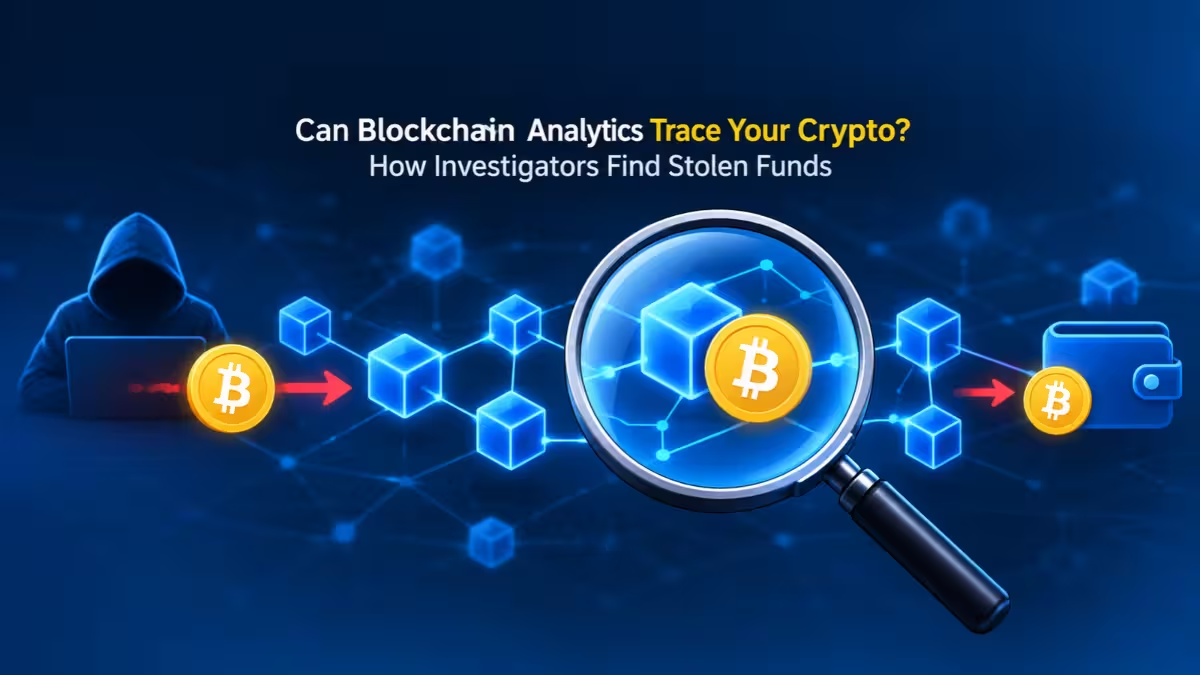
This guide breaks down how the process works, what the tools actually do, and why a wallet address alone rarely proves who sent the money.
Can Cryptocurrency Transactions Be Traced?
A crypto address looks like a random string of letters and numbers. It carries no name, no phone number and no ID. That gives users privacy on the surface, but it does not hide their activity.
Each transaction records the sending address, the receiving address, the amount, a timestamp and a unique hash. Every new transfer links back to earlier ones. Put those links together and you can rebuild the full path of a coin from the moment it entered the network to the wallet that holds it today.
The real puzzle is not visibility. It is meaning. Analysts must figure out which addresses belong together, which ones belong to a known service, and which patterns point to crime rather than normal use.
What Is Blockchain Analytics and How Does It Work?
Blockchain analytics takes raw ledger data and turns it into intelligence a human can act on. The work splits into four jobs.
- Collect and index: Platforms pull data from blockchain nodes or APIs, clean it and store it in a searchable form.
- Group addresses: Algorithms bundle addresses that one person or service most likely controls.
- Label entities: Analysts tag those bundles as exchanges, mixers, scam wallets, ransomware groups or sanctioned actors.
- Score and visualize: The platform rates the risk of each address or transfer and draws the flow of funds as a graph.
When some vendors talk about "blockchain intelligence," they mean the same process with extra off-chain data layered on top, such as exchange records, sanctions lists and open-source research.
How Does Wallet Clustering Link Addresses to One Owner?
One person can control hundreds of addresses. If an investigator looks at only one, they see a tiny slice of the picture. Clustering fixes that.
Common Input Ownership
On Bitcoin, a single transaction can spend coins from several addresses at once. To sign that transaction, the sender needs the keys for all of those addresses. Analysts therefore assume one owner controls them all and merge them into one cluster.
Change Address Detection
Bitcoin works with unspent outputs, much like paper notes. If you pay 0.3 BTC from a 1 BTC output, the wallet sends the leftover 0.7 BTC back to a fresh address it owns. Tools try to spot that change address. If an analyst misreads it, they end up chasing the wrong branch of the trail.
Behavior on Account-Based Chains
Ethereum uses accounts instead of unspent outputs, so the classic Bitcoin tricks matter less. Here analysts lean on behavior: which wallet funded a new address, which contracts it calls, how often it transacts and at what times. Repeated amounts and automated timing often reveal a shared operator.
When the Rules Break
These methods produce leads, not proof. A CoinJoin transaction deliberately mixes inputs from many unrelated users, which breaks the common input rule. A sloppy cluster can lump strangers together. Good investigators write down every assumption so someone else can check it later.
How to Trace Crypto Transactions in 5 Steps
Every case differs, but most investigations follow a similar path.
- Pick a starting point. This might be a victim's deposit address, a ransomware payment, a transaction hash or a wallet on a sanctions list.
- Follow the money in both directions. Map where the funds came from and where they went next, noting every split, merge and hop.
- Attach labels. Overlay known entity tags so each hop shows whether funds touched an exchange, a bridge, a mixer or a gambling site.
- Read the behavior. Ask whether the pattern looks like normal spending or like layering, structuring or a scam cash-out.
- Write it up. Package the trail with timestamps, graphs, labels and confidence levels so a regulator, a bank or a court can follow it.
One warning applies at step two. A ten-hop graph full of arrows can look impressive and still prove nothing. Investigators usually want the cleanest route to a cash-out point, not every possible branch.
Red Flags That Signal Money Laundering on the Blockchain
Risk engines watch for specific behaviors that criminals use to hide funds.
| Pattern | What It Looks Like |
|---|---|
| Peel chain | A wallet sends small amounts forward again and again while passing the remaining balance to a new address each time |
| Layering | Funds jump through many fresh wallets that have no other history or business purpose |
| Microstructuring | A large sum gets chopped into many small transfers to slip under reporting thresholds |
| Chain hopping | Assets cross bridges and swap services to new networks soon after a hack |
| Mixer exposure | Coins pass through pooling services built to break the link between sender and receiver |
| Fast exchange deposit | Funds land on an exchange shortly after a ransomware payment or exploit |
A risk score helps teams decide which alert to look at first. It does not replace evidence. Anyone filing a suspicious activity report or a legal brief still needs the actual transaction trail behind the score.
How Does Cross-Chain Tracing Work Through Bridges and Swaps?
Criminals rarely stay on one network now. A typical laundering run might swap Bitcoin into a wrapped token, trade it on a decentralized exchange, bridge it to another chain, convert it to a stablecoin on TRON and finally cash out somewhere with weak oversight.
Cross-chain tracing tools connect those jumps by matching bridge contract activity, timing, amounts and token event logs on both sides. When funds pass through a well-known bridge, analysts can usually find the matching deposit on the destination chain.
Ethereum adds a trap for beginners. Token transfers such as ERC-20 and ERC-721 movements show up in event logs, not in the plain transaction value. Native ETH moved inside a contract call may not appear in those logs either. Serious investigators pull call-level traces from an archive node so their balances actually add up.
How Do Investigators Identify the Person Behind a Wallet?
On-chain data tells you where money went. Off-chain data tells you who controlled it. Investigators combine the two through sources like these:
- Exchange records: KYC documents, linked bank accounts, login history, device fingerprints and withdrawal addresses.
- Court orders and subpoenas: Legal tools that force regulated platforms to hand over customer data.
- Seized devices: Phones and laptops can contain wallet files, seed phrases, browser extensions and private keys.
- Network data: IP logs, email accounts and VPN timestamps that line up with transactions.
- Dark web and social media: Marketplace vendor profiles, payment addresses and chat handles.
The weakest link for most criminals is the cash-out. They may route funds through ten wallets and a mixer, then deposit at a centralized exchange account opened with a real phone number and ID. That deposit gives police a legal path to freeze the account and request records.
Best Blockchain Analytics Tools for Investigations and Compliance
The market splits into three broad categories.
Transaction screening (KYT) tools check deposits and withdrawals in near real time. Exchanges, custodians and payment firms use products such as Chainalysis KYT and Elliptic Navigator to flag sanctions exposure and risky counterparties before or right after a transfer settles.
Forensics platforms handle deeper casework. Chainalysis Reactor, TRM Forensics and Elliptic Investigator offer graph views, multi-hop tracing, entity labels and exportable reports. Teams working ransomware, pig butchering scams or exchange hacks live in these tools. Merkle Science and Crystal Intelligence compete in the same space.
Compliance infrastructure wraps analytics inside a bigger anti-money-laundering setup with case management, sanctions screening, Travel Rule messaging and audit logs. If alerts do not feed straight into case files, analysts waste hours copying screenshots between systems.
Strong platforms share a few traits: broad and current entity labels, coverage of Bitcoin, Ethereum, Layer 2 networks, stablecoins and TRON, defensible reports with timestamps, and APIs that plug into existing bank systems. Static blacklists alone fall behind, because criminals keep creating new wallets faster than public lists update.
How Is AI Changing Blockchain Forensics?
Vendors now build machine learning into their platforms to catch anomalies across billions of transactions, match entities, triage alerts and summarize cases. TRM Labs, for example, added an AI agent to its forensics product.
AI speeds up the grunt work, but it can also invent connections that do not exist. Treat its output as a suggestion and check every claimed path against the raw transactions before you rely on it.
Real Cases: Silk Road, Colonial Pipeline and Hydra
Silk Road: Investigators tied Bitcoin payments on the dark web marketplace to its operator by pairing blockchain analysis with traditional police work. The case killed the idea that Bitcoin works like anonymous cash.
Colonial Pipeline: Attackers collected 75 BTC, worth about 4.3 million dollars at the time. US authorities followed the ransom on-chain and later recovered roughly 2.3 million dollars from wallets linked to the group.
Hydra Market: German and US agencies traced payments through the Russian-language darknet market, seized wallets holding millions of dollars and shut down its servers. Blockchain data, dark web monitoring and cross-border cooperation all played a part.
Who Uses Blockchain Analytics? Key Use Cases
Exchanges, banks and payment firms screen customer deposits and withdrawals against sanctions lists and risky counterparties. They block or review flagged transfers and file suspicious activity reports when something looks wrong.
Law enforcement and regulators trace stolen or criminal funds, find the exchange where the money lands, and support seizures and prosecutions. Regulators also use the same data to check sanctions exposure and market abuse.
Crypto platforms and DeFi projects watch for account takeovers, scam deposits and wash trading. After a smart contract exploit, their incident teams follow the stolen funds through swaps and bridges to warn exchanges before the money cashes out.
Treasury and risk teams study counterparty exposure and liquidity movement to avoid risky partners and weak collateral.
Can Mixers and Privacy Coins Stop Crypto Tracing?
Tracing works best when criminals touch regulated services. It struggles in a few areas.
- Privacy coins: Monero and shielded Zcash transactions hide sender, receiver or amount by design.
- Mixers and CoinJoin: They lower confidence in links, although analysts can still study entry and exit flows, especially for large or oddly timed amounts.
- Uncooperative jurisdictions: Some offshore exchanges ignore legal requests.
- Speed: Funds can cross five chains in minutes while a court order takes weeks.
- Bad labels: Attributions go stale, services share infrastructure, and a weak tag can send a case in the wrong direction.
A simple table of verified transfers beats a colorful graph built on shaky assumptions. Keep claims narrow and you keep them defensible.
What to Do If Your Crypto Is Stolen
If someone steals your crypto, act fast. Save every transaction hash, wallet address, screenshot and chat log. Report the theft to local police and to the exchange where you think the funds landed. Exchanges can sometimes freeze deposits within hours, and stablecoin issuers can freeze tokens in some cases.
Watch out for "recovery experts" who demand upfront fees and promise guaranteed results. Legitimate forensics firms show verifiable case history, explain their methods and work alongside lawyers and law enforcement rather than around them.
Frequently Asked Questions
Can police really trace Bitcoin transactions?
Yes. Bitcoin records every transfer on a public ledger, so investigators can follow funds from wallet to wallet. They usually identify the owner once the money reaches an exchange that holds KYC data.
Does a mixer make crypto untraceable?
No. A mixer makes tracing harder and lowers confidence, but analysts can still track funds going in and coming out. Authorities have also sanctioned or seized several mixing services.
What is the difference between KYT and blockchain forensics?
KYT tools screen transactions in real time and flag risky ones for compliance teams. Forensics platforms dig deeper after an incident, tracing funds over many hops and producing evidence for cases.
Can blockchain analytics identify a wallet owner by itself?
Not usually. On-chain analysis shows links and patterns. Investigators need off-chain records like exchange KYC files, IP logs or seized devices to confirm a real identity.
Is it harder to trace Ethereum than Bitcoin?
It is different rather than harder. Bitcoin tracing focuses on inputs, outputs and change addresses. Ethereum tracing focuses on accounts, smart contract calls, token event logs and internal transactions.
Which blockchains are hardest to trace?
Privacy coins such as Monero are the hardest, because they hide key transaction details by design. Shielded Zcash transactions create similar problems.
Related Guides
- Ledger Wallets Sold by CryptoBilis Hid a Spy Implant, and Over $86 Million Has Vanished
- Best Crypto Hardware Wallets in 2026: Top 5 Picks
- P2P Crypto Trading Risks: How a Buyer Lost 900 USDT Despite Proof and What You Can Learn
- Fake Software Downloads Are Now Installing Cryptojacking Malware on Your PC
- Top 5 Best Crypto Wallets for Beginners (Hot and Cold Wallets Explained)