You polished your resume with ChatGPT, Claude or Gemini, and now a doubt keeps coming back: will the system flag it, or will the recruiter know? Short answer: software almost never catches it, but people often notice the side effects. The real danger sits in how the resume reads, not in which tool helped you write it.
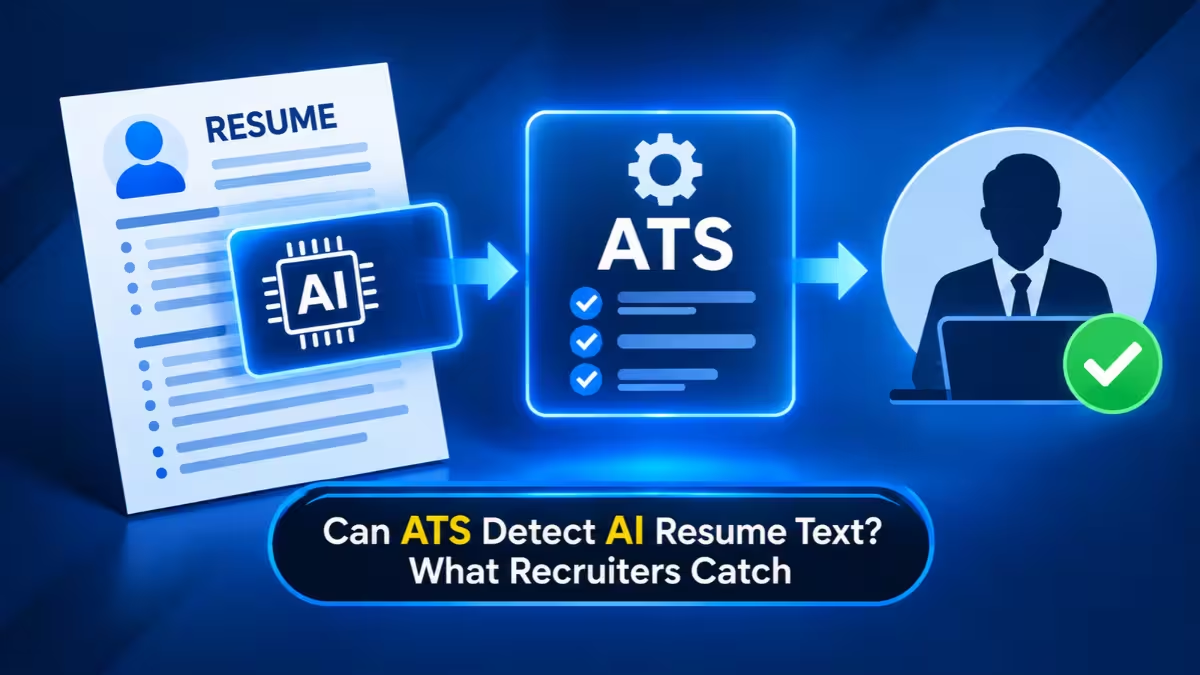
Let's break down what applicant tracking systems do, what AI detectors can and cannot prove, and what makes a hiring manager move your file to the reject pile.
Will an ATS Reject Your Resume for Using ChatGPT or Claude?
- No mainstream ATS includes a feature that identifies AI authorship. Workday, Greenhouse, Lever, iCIMS, SAP SuccessFactors, Oracle and Ashby all use AI to match candidates to jobs, not to judge who wrote the text.
- Standalone AI detectors exist, and some recruiters paste resumes into them. Their accuracy on short, formulaic writing like resumes is poor.
- Recruiters reject generic writing, not AI. Vague bullets, buzzwords and claims you cannot explain in an interview cost you the callback.
- Broken formatting kills more applications than suspected AI ever does.
How Workday, Greenhouse, Lever and iCIMS Score Your Resume
An applicant tracking system receives your file, splits it into fields like job titles, employers, dates, skills and education, then stores it. Most modern platforms go one step further and score or rank you against the job requirements before a human looks at anything.
Here is how the big platforms handle ranking:
| Platform | How it sorts candidates | Checks AI authorship? |
|---|---|---|
| Workday (HiredScore) | Grades applicants A, B, C or D on job fit | No |
| Greenhouse | AI-assisted Talent Matching; humans make every decision | No |
| Lever | Talent Fit ranking with plain-English explanations | No |
| iCIMS | Candidate Ranking through Coalesce AI | No |
| SAP SuccessFactors | Joule stack-ranks applications by skills and experience | No |
| Oracle Recruiting | Scores applicants 0 to 5 across education, experience, skills and profile match | No clear signal disclosed |
| Ashby | Marks each criterion as "Meets" or "Does not Meet" without ranking | No |
| BambooHR, UKG | Mostly keyword filtering | No |
Notice the pattern. These tools care about what your resume says. Some newer modules hunt for fraud, but they look at signals like IP address, phone number, email and location to catch fake or bot-driven applications. Your writing style does not enter that check.
Oracle's recent screening agent template mentions confidence scores to spot fraudulent or AI-generated candidates, but Oracle has not explained which signals it reads. Treat that as an exception to watch rather than an industry standard.
Do Recruiters Run Resumes Through GPTZero or Other AI Detectors?
Tools like GPTZero, Originality.ai and Copyleaks estimate how "machine-like" a passage reads. They mostly look at two things:
- Perplexity: how predictable each word choice is.
- Burstiness: how much sentence length and structure varies.
Resumes break both measurements. Good resume writing uses short, parallel bullets, standard action verbs and tight industry phrasing. That style looks predictable and uniform by design, so a resume you wrote entirely by hand can still score as "likely AI."
The track record of these tools backs this up:
- OpenAI pulled its own AI text classifier in 2023 after it correctly identified only 26% of AI-written text. The company also said it performed badly on passages under 1,000 characters. A resume summary rarely crosses that length.
- A Stanford-led study found that popular GPT detectors wrongly flagged more than 61% of essays by non-native English writers as AI-generated, even though humans wrote every one.
- Light editing and paraphrasing drop detection scores sharply.
So even if a recruiter runs your file through a detector, the score proves nothing. Careful employers know this, and few treat a detector result as grounds for rejection on its own.
Which Resume Habits Make Recruiters Suspect AI?
Hiring managers skim fast. Most spend less than a minute on a first pass, and many spend under 30 seconds. In that window they don't analyse your grammar. They ask one question: does this person clearly fit the role?
Unedited AI output fails that test because it says nothing specific. These patterns give it away:
Bullets that could belong to anyone
"Drove cross-functional initiatives to enhance operational excellence" describes thousands of people. It names no project, tool or result, so the reader learns nothing about you.
Results without numbers or context
"Significantly improved team efficiency" leaves the obvious questions open. Improved from what, to what, and how did you measure it?
Identical rhythm in every bullet
When every line runs the same length and follows the same verb, task, metric pattern, the page starts to feel manufactured. Real work is uneven, and honest descriptions of it usually show that.
Buzzword piles
"Dynamic, results-driven professional with a proven track record" stacks positive words with no proof behind them. Words like "spearheaded" or "leveraged" aren't banned on their own. The problem appears when the verb does all the work and the facts go missing.
Wording lifted straight from the job post
Matching the employer's terminology helps when it describes your real experience. Copying the posting line by line makes you look forced, and sometimes it claims duties you never handled.
Claims that collapse in the interview
This one hurts most. AI happily invents tidy metrics like "boosted productivity by 312%" or adds tools you never touched. If the interviewer asks you to walk through that number and you can't, you lose credibility on the spot.
Why Bad Formatting Gets More Resumes Rejected Than AI Does
Many people blame AI when an application vanishes, but a corrupted parse often causes the silent rejection. Multi-column layouts, tables, text boxes, graphics and contact details buried in headers can scramble the text before the ranking engine reads it.
When that happens, the system may misread your experience and rank a qualified candidate near the bottom. A plain, single-column .docx or text-based PDF with clear headings, titles, dates and employers keeps you safe.
Do Hiring Managers Reject AI-Assisted Resumes?
Survey results paint a mixed but consistent picture:
- Roughly half of hiring managers accept AI for drafting and proofreading.
- About one in five say they would reject a resume they believed was fully AI-generated.
- A clear majority say they would reject AI resumes that lack personal detail, and most say personalized specifics matter more than polished phrasing.
- Many hiring managers claim they can spot AI writing within seconds, though that reflects their confidence, not a tested accuracy rate.
The takeaway stays the same across every survey. Employers don't punish the tool. They punish empty, unedited output.
How to Use ChatGPT or Claude on a Resume Without Hurting Your Chances
Think of AI as an editor, not an author. You bring the facts, and the model helps you present them clearly.
- Start with raw material. Before you prompt anything, list your real projects, tools, team sizes, numbers and problems you solved. Specific input produces specific output.
- Set strict limits in your prompt. Tell the model to use only the facts you provide, keep every title, employer and date unchanged, and never invent metrics. Ask it to question you when evidence looks thin.
- Replace every vague line. Swap "improved customer satisfaction" for something like "cut average ticket resolution time from 31 hours to 19 by setting up a triage queue."
- Trace every number. If you can't explain where a figure came from, delete it.
- Give recent roles more space. Your latest and most relevant jobs deserve the most bullets. Summarize older positions in a line or two.
- Add one detail per role only you would know. A project name, an internal tool, a constraint you worked around. Nobody can fake that.
- Read it out loud. If a sentence sounds unlike anything you would say to a recruiter on a call, rewrite it.
- Run the 90-second test. Pick any bullet at random and talk about it for 90 seconds: what you did, which tools you used, who helped and what changed. Rework any bullet you can't explain.
- Check the format. Use a single column, standard section headings and no tables or text boxes.
Resume Bullet Rewrites: Generic AI Line vs Specific Human Line
Before: "Leveraged data-driven insights to optimize marketing performance." After: "Shifted 40% of paid search budget into three long-tail campaigns after a SQL cohort analysis; cost per signup fell 22% in one quarter."
Before: "Results-driven software engineer passionate about scalable solutions." After: "Backend engineer with six years in payments. Moved 14 services to Kafka and cut p99 latency by 35%."
Before: "Responsible for managing the social media calendar." After: "Planned and scheduled 60 posts a month across three channels and grew Instagram followers from 8,000 to 13,500 in six months."
Each rewrite names something concrete, includes a real number and shows ownership. That's what makes a resume read as human, regardless of who typed it.
Do You Need to Disclose AI Use on a Job Application?
You don't need to volunteer it, just as you wouldn't mention a spell checker or a template. Some employers now ask about AI use directly on application forms, though. If a form or an interviewer asks, answer honestly: you used AI to tighten the wording and tailor the document, and every claim, title, date and metric is yours.
Don't run your resume through AI "humanizer" tools to dodge detectors. That chases a score from tools that already misfire, and the output often ends up just as hollow.
The fear of an ATS silently catching your AI-assisted resume doesn't match how these systems work. Software ranks you on fit, and people judge you on proof. Feed AI your real experience, cut anything generic, verify every claim and keep the layout simple. Do that, and nobody will care which tool helped you write it.
Frequently Asked Questions
Will an ATS reject my resume for being AI-written?
No. Mainstream systems parse and match your content against job requirements. They don't analyse authorship.
Do recruiters use AI detectors?
Some do, mostly outside the ATS. Detector scores misfire often on resumes, so serious recruiters rarely rely on them alone.
Is using ChatGPT or Claude for a resume cheating?
No, as long as everything stays accurate. Inventing skills, metrics or job titles is the real problem, and it would be dishonest with or without AI.
Do I need to delete words like "spearheaded"?
Not necessarily. Those words appeared on resumes long before AI tools existed. Focus on adding specifics instead of hunting individual words.
What matters most before I hit submit?
Clean formatting, accurate facts, real numbers and bullets you can explain in detail during an interview.