Google has officially announced the transition to the IAB Europe Transparency and Consent Framework (TCF) v2.3, setting a final deadline of February 28, 2026. This move aims to align with evolving privacy standards, ensuring greater transparency and user control over data used in advertising.
If you’re an AdSense or Ad Manager publisher, here’s everything you need to know — including who needs to act, what changes, and what happens if you don’t update in time.
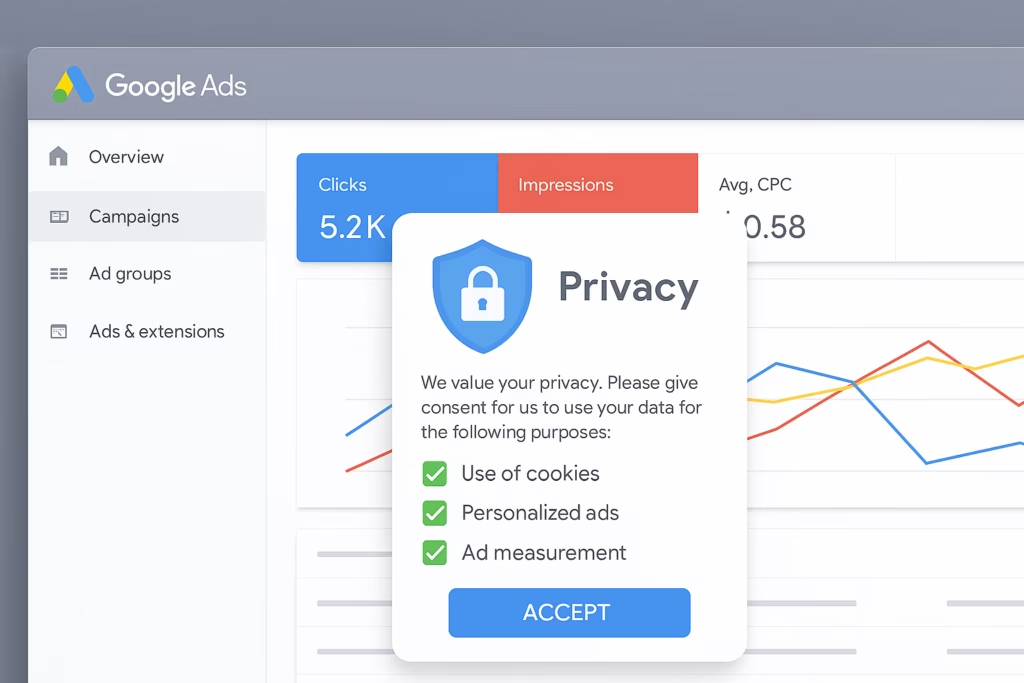
What Is IAB TCF v2.3?
The Transparency and Consent Framework (TCF) is a set of standards developed by IAB Europe to help websites comply with GDPR and ePrivacy Directive requirements. It allows publishers, advertisers, and consent management platforms (CMPs) to clearly communicate and record user consent preferences.
With version 2.3, new fields and improvements have been introduced to enhance data transparency, interoperability, and accountability across the ad tech ecosystem.
Transition Timeline
Google has outlined a structured transition period so publishers and CMPs can adapt smoothly:
| Phase | Period | Description |
|---|---|---|
| Support Live | November 2025 | Google’s systems can already process TCF v2.3 strings. You can start migrating now. |
| Transition Period | November 2025 – February 2026 | Google will treat v2.2 and v2.3 strings equally. This allows safe testing before enforcement. |
| Final Deadline | February 28, 2026 | TCF v2.3 becomes mandatory. Any new TCF v2.2 strings created after this date may lead to Limited Ads, affecting revenue. |
Required Actions for Publishers
Google has made it clear that early coordination is key to avoid ad-serving disruptions.
If You Use Google’s CMP (Site Kit or AdSense):
Good news — No action is required.
Google will automatically start writing TCF v2.3 strings across your properties before the February 2026 deadline.
If You Use a Third-Party CMP:
You must:
- Contact your CMP immediately to confirm their plan and timeline for TCF v2.3 compliance.
- Test and deploy the updated implementation before the deadline.
- Verify that your CMP properly passes the Transparency and Consent (TC) string to Google’s ad tags or SDKs.
Failing to transition in time could result in Limited Ads, which may reduce ad performance and revenue.
What Changes for Ad Serving
1. Personalized Ads Require User Consent For:
- Purpose 1: Store and/or access information on a device
- Purpose 3: Create a personalized ads profile
- Purpose 4: Select personalized ads
Google also requires either legitimate interest or consent for:
- Purpose 2: Select basic ads
- Purpose 7: Measure ad performance
- Purpose 9: Apply market research to audience insights
- Purpose 10: Develop and improve products
If all these purposes are approved, personalized ads can be served as usual.
2. Non-Personalized Ads Conditions
If a user does not give full consent for personalized ads, Google may serve non-personalized ads (NPA) provided the user consents to:
- Purpose 1: Storing/accessing information
- Legitimate interest for Purposes 2, 7, 9, and 10
However, if Purpose 1 consent (for cookies or identifiers) is missing, even non-personalized ads cannot serve — only Limited Ads will appear.
How the TC String Works
The TC (Transparency and Consent) string is a signal generated by your CMP that communicates user choices about data usage.
Google’s AdSense, Ad Manager, and SDKs automatically read and process this string to determine which ads to serve.
If your TC string is invalid, missing, or outdated, ad serving may pause until proper consent data is received.
The move to IAB TCF v2.3 is part of Google’s broader commitment to data transparency and privacy-first advertising. For most small publishers using Google’s CMP (via Site Kit or AdSense), this update will happen automatically.
However, those relying on third-party CMPs should coordinate with their providers immediately to prevent revenue disruptions as the February 2026 deadline approaches.

