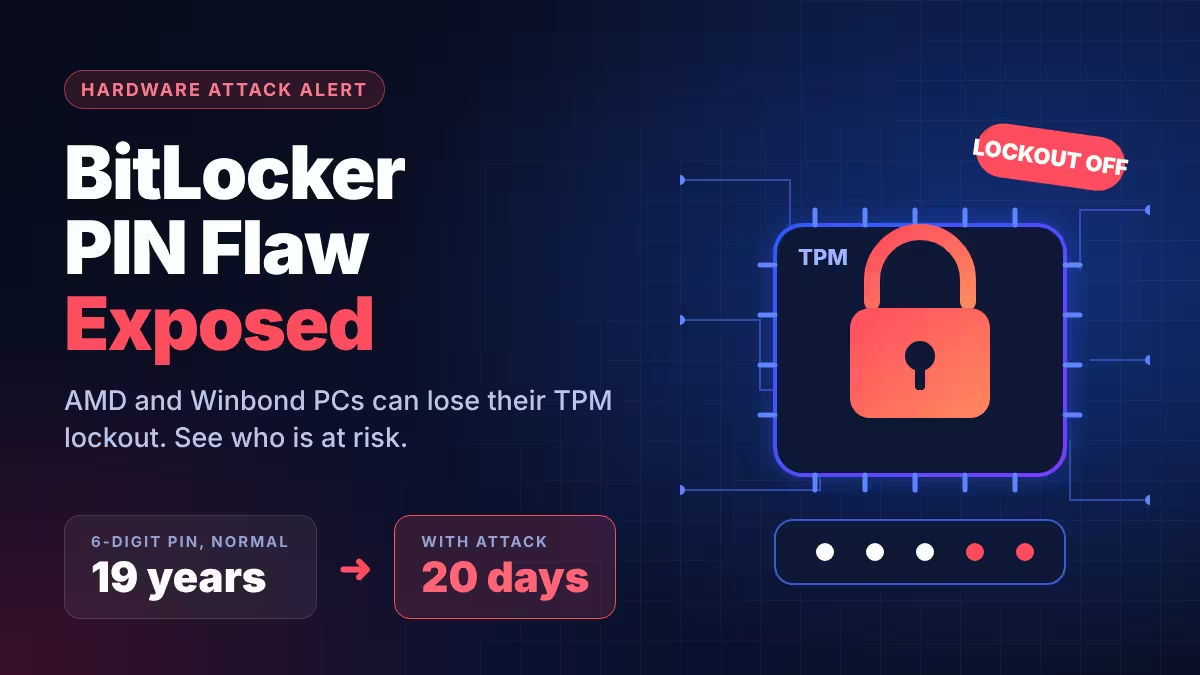
A stolen laptop with a short BitLocker or Windows Hello PIN is now easier to crack than most people assume. Researchers at Technische Universität Berlin showed that an attacker who opens the case can freeze the wrong-guess counter that normally slows PIN guessing. The result: a six-digit BitLocker PIN that should take about 19 years to guess falls to roughly 20 days.
This guide explains what the attack does, which PCs it affects, and what you can do today.
What Is the BitLocker and Windows Hello PIN Flaw?
Windows relies on the TPM to limit PIN guesses. After 32 wrong tries, the TPM locks, and it forgives one failure every 10 minutes. That delay is what makes a short PIN safe enough on a stolen device.
The Berlin team found a way to defeat that delay on many AMD PCs and on PCs that use certain Winbond flash chips. They did not break the encryption itself. They stopped the PC from remembering how many wrong guesses it had already seen.
Two lab tests prove the point:
- AMD laptop (HP OmniBook 3, Ryzen AI 5 330): the team found a four-digit Windows Hello PIN, 1235, after 236 tries in 57 minutes.
- Intel laptop (Framework Laptop 13, Core Ultra 5 125H, Winbond flash): the team found a six-digit BitLocker PIN, 123457, after 236 tries in 6 minutes and 55 seconds.
Both PINs came from the researchers, so the tests show the method works, not that real-world thieves are using it. The researchers also say both attack methods should work against either PIN type, but their tests did not cover that.
How Attackers Bypass the TPM Lockout
Most modern PCs use a firmware TPM (fTPM) that lives inside the processor. Unlike a separate TPM chip, an fTPM has no private storage. It saves its state, including the failed-guess count, in encrypted form on the flash chip on the motherboard.
That design opens a door. If an attacker can reset or fake that stored count, the lockout never triggers. The researchers used three routes:
- Roll back the flash: Copy the flash chip's contents while the count is low. After you use up your free guesses, write the old copy back. The count returns to its earlier value.
- Block the counter update on AMD: Newer PCs add a hardware counter inside the flash chip, called RPMC, that only moves forward. On AMD PCs that use it, the processor firmware never checks that the counter actually went up. A small board placed between the processor and the flash chip can swallow the update and report success.
- Steal the signing key from Winbond chips: A brief voltage drop (a glitch) makes some Winbond RPMC chips leak the secret key that signs their counter values. With that key, the attacker's board can forge any counter value. It took about one second to pull the key with the best settings.
On the Intel laptop, one glitch was enough. The laptop's firmware uses the same value at every boot, so the stolen key kept working after each restart.
In both tests, the team removed the flash chip from the mainboard and wired in a custom board. A script read the screen, typed PINs, and restarted the laptop through a KVM switch. Windows still forced a restart after every five wrong attempts, but the lockout delay never applied. For BitLocker, each reset handed the attacker a fresh set of 32 tries.
Which AMD, Intel and Winbond PCs Are Affected?
Your risk depends on the processor and the flash chip.
- AMD PCs with RPMC flash: open to the counter-blocking board. AMD confirmed the firmware flaw behind this.
- AMD PCs without RPMC flash: on two AMD desktops, writing an old flash copy back with an ordinary programmer reset the count. No custom board was needed. Two desktops are a small sample, so treat this as a strong warning, not a final count.
- Any PC with Winbond RPMC flash: the researchers say the key-leak method works whatever the processor, and only a new chip design can fix it.
- Intel PCs without RPMC-style flash: three Intel systems detected the same write-back and refused it.
Intel says the research did not show a vulnerability in an Intel component, which fits the tests: the Intel laptop fell only because of the Winbond chip.
The researchers expect the AMD flaw to also touch AMD PCs that use the Microsoft Pluton security core as their TPM, but they did not demonstrate it.
How to Check If Your PC Is Vulnerable
On an AMD PC, boot Linux from a live USB stick and run this command:
grep . /sys/bus/pci/drivers/ccp/*/rpmc_*
The output tells you whether RPMC flash is present and enabled. Missing files do not prove your PC lacks RPMC.
For Intel PCs, no simple software check exists. You would need to open the case and look for a Winbond chip marked 25R or 74M.
How Fast Can a BitLocker PIN Be Cracked Now?
The researchers calculated worst-case times from speeds they measured on one laptop each. Treat these as estimates, not guarantees.
- Four-digit PIN: 69 days with the lockout working. The attack cuts it to 40 hours for Hello on the AMD laptop and about 5 hours for BitLocker on the Intel laptop. Windows only accepts a four-digit BitLocker PIN if an admin lowers the six-digit minimum.
- Six-digit PIN: 19 years with the lockout working. The attack cuts it to 168 days for Hello and 20 days for BitLocker.
- Eight-digit PIN: 1,903 years with the lockout working. The attack cuts it to 46 years for Hello and 6 years for BitLocker.
Two extra digits stretch the attack from hours to months, and four extra digits push it into years.
How to Protect Your PC From the BitLocker PIN Attack
You cannot fix the flash chip yourself, so focus on what you control.
For everyday users
- Use a longer PIN. Add at least two digits to your Hello and BitLocker PINs. The researchers advise this as the minimum.
- Consider a BitLocker PIN with letters and symbols. Turn on the "Allow enhanced PINs for startup" policy to enable it. This helps most on older hardware.
- Keep your laptop in sight when you travel. Every attack here starts with physical access.
- Watch for signs of tampering, such as scratches, loose screws, or a case that no longer sits flush.
- Install BIOS and firmware updates as soon as your PC maker releases them. Back up your BitLocker recovery key first, since some BIOS updates trigger a BitLocker recovery loop.
For IT admins
- Raise the Minimum PIN length policy for Windows Hello for Business under Computer Configuration > Administrative Templates > System > PIN Complexity.
- Raise the "Configure minimum PIN length for startup" policy for BitLocker. It accepts 4 to 20 digits.
- Keep TPM+PIN in place if you moved away from TPM-only BitLocker after the YellowKey bypass. This attack targets the PIN's lockout, so a longer PIN matters more than ever.
- Ask your PC vendor which models ship with Winbond RPMC flash and whether a fix exists.
AMD, Microsoft, Intel and Winbond Fix Status
AMD tracks the flaw as CVE-2026-43613 with a CVSS score of 5.1. The company says attacks that need physical access fall outside its product threat model, yet it also states that RPMC is meant to stop this type of attack.
AMD plans firmware fixes for most Ryzen, Ryzen AI, Ryzen Threadripper, Athlon, and EPYC chips between November and February. One product has no date yet. These are planned dates for AMD's own firmware, so PC makers still need to ship the updates.
AMD's bulletin leaves two gaps. It does not cover PCs without RPMC flash, and it does not say whether the fix will block an attacker from installing older, unfixed firmware.
Microsoft rated the Hello report as moderate severity, issued no CVE, and said it will raise its recommended minimum Hello PIN length to six digits. A recent Windows 11 test build already makes six digits the minimum for personal-account PINs, with an option to use four. Test builds do not always reach regular releases.
Winbond is studying the issue, possibly with a new chip design, but has made no commitment on a fix or a date.
Intel says the research did not demonstrate an Intel vulnerability and advises customers to ask their PC maker about updates.
The researchers have published their attack firmware, board designs, and scripts. They also say the RPMC attacks need one of their custom boards and are not plug-and-play. No source so far describes attacks outside the lab.
Frequently Asked Questions
Does this attack break BitLocker encryption?
No. It defeats the guess limit on your PIN. The attacker still has to guess the correct PIN, and a longer or more complex PIN makes that far harder.
Can someone do this remotely?
No. The attack needs physical access to the motherboard. The attacker must open the PC and connect a board to the flash chip.
Is my PC safe if it has an Intel processor?
Not automatically. Intel PCs that use Winbond RPMC flash are open to the key-leak method. Intel PCs without RPMC-style flash detected the rollback in the researchers' tests.
Is a four-digit Windows Hello PIN still safe?
It is the weakest option. The attack cracks a four-digit Hello PIN in about 40 hours in the worst case. Move to six digits or more.
Will a BIOS update fix everything?
No. AMD plans firmware fixes for the processor-side flaw, but a software update cannot repair the Winbond chip weakness. That needs a new chip design.
What is the single best step I can take today?
Lengthen your PIN. Adding two digits turns a worst case of hours into months, and a PIN with letters and symbols goes further.
Related Guides
- A USB Stick Can Unlock Your BitLocker Drive: Fix CVE-2026-45585 Before Attackers Do
- BitLocker Vulnerability CVE-2026-27913 Lets Attackers Bypass Security: Fix Now
- How to Find Your BitLocker Recovery Key in Windows 11/10 [4 Methods]
- Microsoft Shares Private BitLocker Recovery Keys With FBI in First Known Case
- Fix BitLocker Recovery Key Prompt on Every Boot in Windows 11