NordVPN has announced a major rebrand, shifting its identity from a standalone VPN provider to a full all-in-one security app. The updated application now bundles next-generation antivirus, dark web monitoring, and scam protection alongside its core VPN service, all in a single interface.
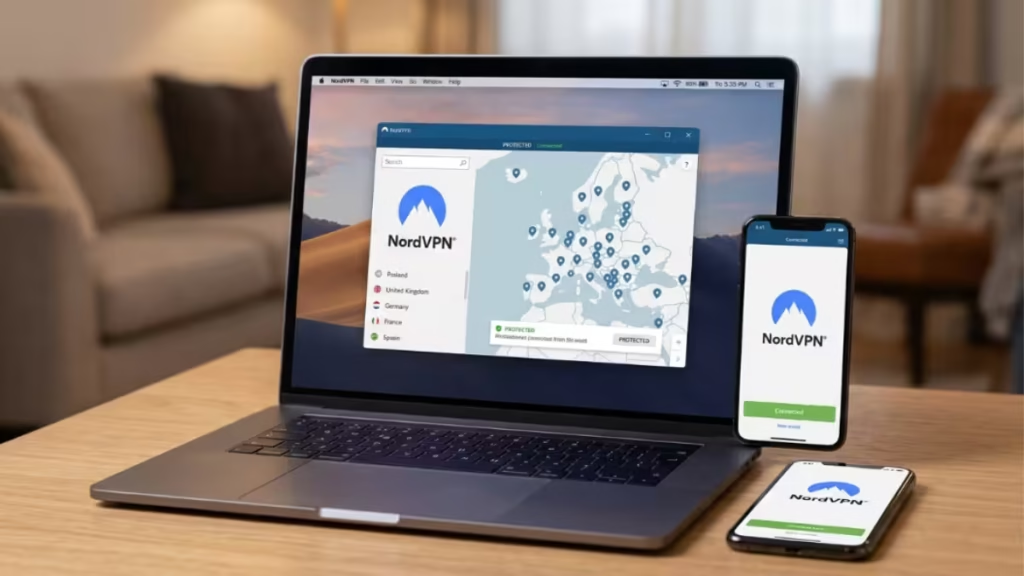
The change reflects how online threats have evolved well beyond traditional malware. Phishing pages, fake online stores, scam messages, and account takeover attempts now cause more damage than downloadable viruses ever did. NordVPN is restructuring its app to meet that reality.
If you currently use NordVPN as a VPN to protect yourself from hackers and scammers, this rebrand extends that protection into territory a VPN alone cannot cover.
What Changed in the NordVPN App
NordVPN reorganized its entire application around three core pillars:
- Connect covers the VPN service, the feature NordVPN built its reputation on.
- Protect rebrands the former Threat Protection Pro suite as next-generation antivirus.
- Monitor groups tools like Dark Web Monitor, scam call detection, and breach alerts.
The most significant shift is the renaming and repositioning of Threat Protection Pro. That suite now carries the “next-generation antivirus” label, signaling to users that NordVPN sees itself as a direct alternative to standalone antivirus software rather than just a companion to it.
Domininkas Virbickas, product director at NordVPN, described the update as a way to let users access the VPN, scam and phishing protection, and monitoring tools from a single app, instead of treating them as separate products.
Why NordVPN Is Moving Beyond Traditional Antivirus
Traditional antivirus software was built around one task: detecting malicious files on your device. That approach worked well when most threats arrived as downloadable executables. It no longer covers the full threat picture.
Today, cybercriminals rely heavily on deception. Phishing pages mimic real banks and services. Fake online stores collect payment details without delivering anything. Scam calls use spoofing and impersonation to steal credentials. Account takeover attempts use leaked passwords from previous data breaches, not malware at all.
As NordVPN CTO Marijus Briedis put it, people still use the word “antivirus” as shorthand for digital security, but the threats they need protection from have changed dramatically. NordVPN’s position is that protection needs to evolve alongside those threats.
This shift also explains why a no-logs VPN alone is no longer sufficient for full privacy and security. Encrypting your traffic does not stop you from clicking a convincing phishing link or entering your password on a spoofed login page.
What Next-Generation Antivirus Actually Does
NordVPN’s next-generation antivirus operates across two detection layers rather than relying on a single file-scanning engine.
Layer 1: Web-level detection
- When you visit a URL or click a link, NordVPN checks the domain and address in real time using threat intelligence feeds, rule-based systems, and machine learning models trained for specific threat types. Phishing URL detection and scam pattern recognition run at this layer before you ever land on the page.
Layer 2: Device-level detection
- If a threat reaches your device, a second layer uses file scanning powered by machine learning models designed to identify malware before it executes.
Virbickas explained the distinction clearly: the difference is not only what is being detected, but when. The goal is to prevent harm before the user has to deal with cleanup.
In April 2026 alone, NordVPN’s next-generation antivirus blocked 4.8 million threats. Malware accounted for over 3 million of those blocked events. Phishing, scams, malicious websites, and other harmful content made up the remainder.
The full next-generation antivirus feature set includes:
- Scam and phishing protection
- Malware detection and blocking
- Ad and tracker blocking
- Identity and account takeover protection
- File and device scanning
Privacy-First Security Design
One of the legitimate concerns with all-in-one security suites is the level of system access they require. Traditional antivirus products often need deep device permissions, which can raise questions about what data the software collects and how it uses that data.
NordVPN addresses this directly. Its stated approach is to collect the minimum signal required to make a threat decision, and to avoid turning security software into a surveillance product.
Where possible, checks happen locally on the device. When server-based analysis is necessary, NordVPN strips identifying information from the data before processing.
This privacy-first design extends across the full suite, from the core VPN to the machine learning models used for specific threat categories. For users who already pay attention to details like paying for a VPN anonymously or using cryptocurrency to pay for a VPN, this matters. A security tool that undermines the privacy it claims to protect is counterproductive.
NordVPN Plans and Pricing After the Rebrand
NordVPN currently offers three subscription tiers. Not all features are available on every plan.
| Plan | Monthly Price | Key Features | Next-Gen Antivirus |
|---|---|---|---|
| Basic | $3.09 (2-year) | VPN, scam and phishing protection, Dark Web Monitor, up to 10 devices | No |
| Complete | $3.99 (2-year) | Everything in Basic plus anti-malware, ad and tracker blocking, phishing email alerts, spam call detection, breach alerts, password manager | Yes |
| Prime | Custom pricing | Everything in Complete plus identity theft protection and cyber insurance via Coveron | Yes |
All plans carry a 30-day money-back guarantee and include the option to upgrade after purchase. Three months of free access are added to every two-year subscription.
NordVPN is not the only VPN provider expanding its feature set. Surfshark, which operates independently under the Nord Security umbrella, also bundles antivirus features in its plans. ExpressVPN has added credential management and email masking. Proton has launched a security-focused productivity suite. The trend is consistent: VPN providers are broadening their security portfolios as the line between VPN and antivirus continues to blur.
For users who want more advanced privacy configurations alongside NordVPN’s new feature set, it is worth reviewing how tools like double hop VPN work and whether adding an extra encryption layer suits your specific threat model. If you also use your VPN for banking, reading up on VPN split tunneling for online banking will help you avoid common access issues with financial apps.

