This happens constantly. A freelancer submits work, and it comes back rejected because a detector flagged it as 66% AI-generated. The writer never touched ChatGPT. It doesn’t matter. The client already found someone else. Freelance platforms are leaning harder on these scores every quarter, and a single bad number can undo months of client trust built up through nothing but consistent, careful work.
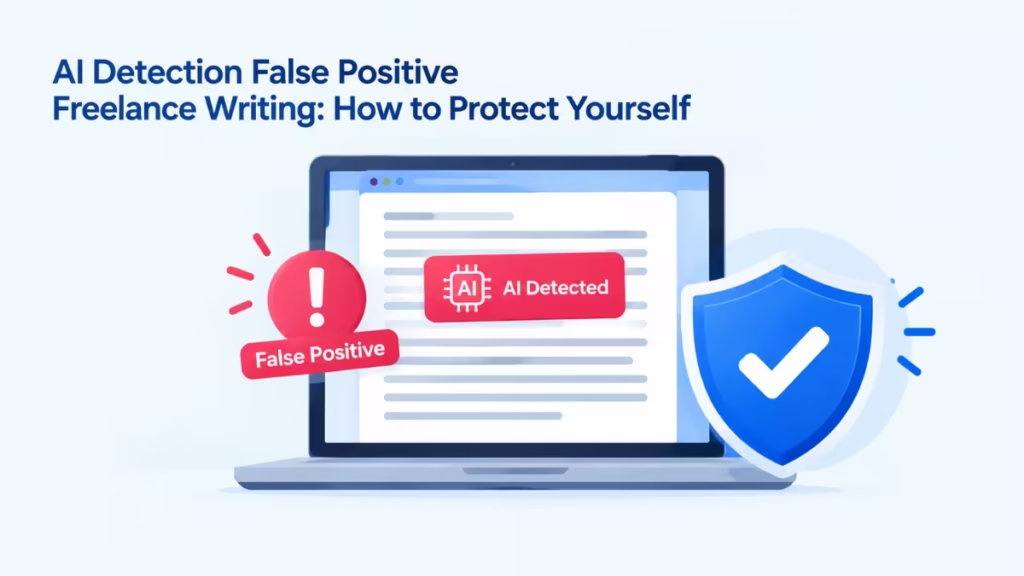
Multiply that scene across a freelance platform with thousands of active contracts and the pattern becomes obvious. Detection tools weren’t built to referee freelance work. They were built to catch students pasting essay content wholesale, and freelance platforms adopted them anyway because a false positive costs the platform nothing while a missed violation costs it credibility.
Why do detectors flag legitimate freelance writing?
Because precision looks suspicious to a machine trained to spot AI. Detection tools key off patterns that show up naturally in careful, technical, or non-native English prose, exactly the traits a good freelancer is trained to produce. The writers who get burned the worst are often the most careful ones. The tools were trained to catch a different kind of text altogether, generic, unedited, first-draft AI output, and they were never recalibrated for the writers whose entire job is producing clean, error-free prose by hand.
What does a false accusation actually cost?
More than the one lost contract, usually. A freelancer flagged once often gets flagged again, since some platforms keep an internal note attached to the account even after a dispute gets resolved in the writer’s favor. Clients who see a flag before they see the writer’s portfolio tend to walk, whether or not the flag ever gets explained. The financial hit is real, but the reputational one lingers longer.
Long-term client relationships take the biggest hit, since a single flag can undo years of trust built through consistent delivery. A client who has worked with the same freelancer for two years might still pause and ask questions after seeing a detector score, even when nothing about the working relationship has actually changed. Rebuilding that confidence usually takes longer than the dispute itself.
How should a freelancer respond when a client sends over a flagged score?
Ask what tool produced it, first. Different detectors have wildly different false-positive rates, and knowing which one flagged the work tells you how seriously to take the number. Then send whatever drafting evidence exists, an outline, a timestamped document history, an early version with fewer edits, before the conversation turns adversarial. Waiting until a client has already decided rarely goes well, no matter how strong the evidence turns out to be.
Which tools actually help?
Five are worth knowing about, and they don’t all work the same way:
- Grammarly. Pushes prose toward a looser, less templated rhythm, the opposite of what most detectors flag. It won’t save a draft pasted straight from ChatGPT, but it smooths out the repetitive phrasing that sometimes reads as machine generated even when a human wrote every word.
- Hemingway Editor. Strips passive voice and flags sentences that run too long, both of which push writing further from how AI models write. Generated text tends to read as unusually smooth and even, so a rougher, more uneven draft works in a writer’s favor here.
- ProWritingAid. Goes deeper than Grammarly on repetition and sentence-length variety, the two things detection algorithms weigh most heavily. Writers who get flagged tend to write in unusually consistent sentence lengths, a habit this tool is built to catch.
- Originality.ai. Worth running on your own writing before you submit it, not to game anything, just to see what a client’s detector might see. A personal essay scoring 80% AI-likely is worth knowing about before a client sees that number cold.
- A documented drafting process. Not a tool exactly, but the most reliable option on this list. An early outline with a timestamp, plus visible revision history, beats any detector score as evidence.
- Screen recording software. A growing number of freelancers record their screen while drafting client work, not for any one client in particular, but so unambiguous proof exists if a dispute ever escalates past a polite email.
Does switching detectors help, or just move the problem?
Not really. Freelancers sometimes assume that if Grammarly’s built-in checker or Originality.ai clears a piece, every client’s detector will too. It won’t. Detectors disagree with each other constantly, since each one trains on a different sample of AI and human writing, and a draft that scores 5% AI-likely on one platform can score 60% on another. Running a piece through several tools before submitting doesn’t guarantee a clean bill, but it does show which drafts are borderline enough to need a paper trail ready in advance.
Is it worth disclosing AI use before a client asks?
Usually, yes. A freelancer who mentions upfront that a first draft came from Claude and was then rewritten and fact-checked rarely gets flagged for it later, because the client already has the context a detector can’t provide. The freelancers who get burned are almost always the ones who said nothing and then got asked to explain a number they didn’t know existed.
What beats every tool on this list?
Keeping a visible drafting trail. Google Docs keeps revision history automatically, which means most writers already have the evidence and don’t know it. A detection score is a guess dressed up as certainty. A drafting history is the opposite of a guess.
None of this fixes the underlying problem, which is that platforms are outsourcing a judgment call to software that was never built for it. Until that changes, the writers who protect themselves best are the ones who treat every project like it might someday need to be defended, keeping drafts, timestamps, and a paper trail as a habit rather than a reaction.
AI detection isn’t going away, and freelance platforms keep getting more aggressive about screening submissions. Activated Thinker covers which AI writing tools protect freelancers from false AI accusations in more depth, worth reading if this has happened to you.
Read More
