Microsoft has not officially announced Windows 12. That single fact matters more than the hundreds of leaks, concept renders, and speculation pieces that have flooded tech publications since 2024. Yet underneath all that noise sits a genuinely interesting story about where Windows is headed, and Build 2026 is the clearest window yet into that direction.
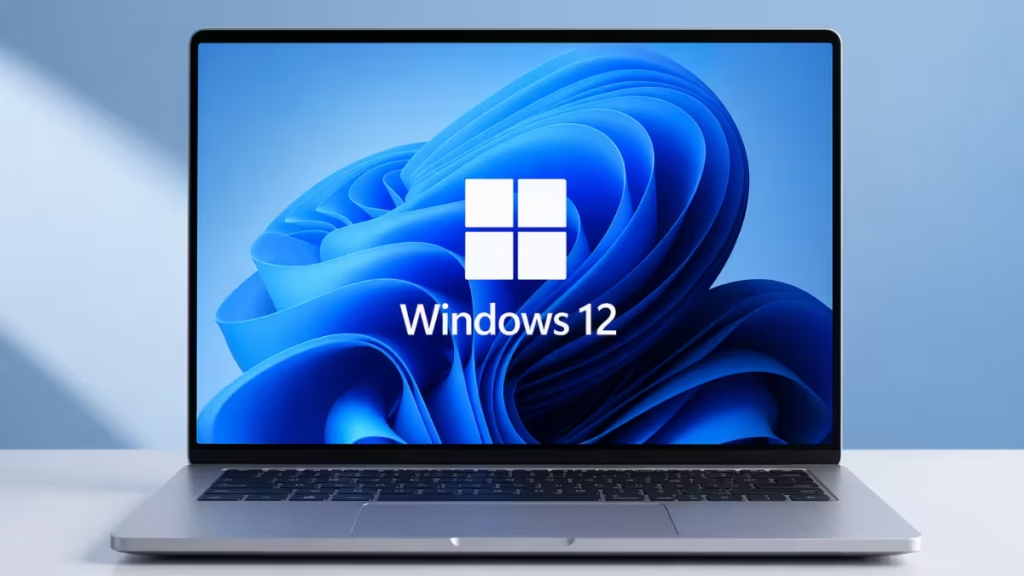
Is Windows 12 Actually Coming?
The short answer is: probably, but not in 2026.
In early March 2026, PCWorld published a widely shared report claiming Windows 12, codenamed “Hudson Valley Next,” would ship later that year, built on a modular CorePC architecture and requiring an NPU with at least 40 TOPS of performance for full functionality. The piece spread fast. PCWorld’s own executive editor later added an editor’s note walking back many of those claims, noting the article was a translated syndication from German partner PC-Welt published without secondary verification.
Windows Central’s Zac Bowden went further and debunked the report based on independent sources. According to Bowden, Microsoft has no plans to ship Windows 12 in 2026. The “Hudson Valley” codename traces back to 2023, where it was tied to Windows 11 planning, not a new OS. CorePC was similarly an internal 2023 project that never shipped. Bowden’s assessment puts 2027 as the earliest realistic announcement window.
Microsoft’s own public statements reinforce this. At CES 2025, the company described 2025 as “the year of the Windows 11 PC refresh,” signaling no imminent OS jump. In February 2026, Microsoft clarified on its official Microsoft Learn platform that it has not announced Windows 12. The next major update on the public roadmap remains Windows 11 26H2.
Windows 12 is a real long-term product direction, but any specific 2026 launch claim has been broadly debunked.
What Microsoft Is Actually Doing to Windows in 2026
While Windows 12 speculation runs hot, Microsoft is running a focused quality initiative on Windows 11 that tells you more about the platform’s real trajectory than any leak.
Windows Central has reported on an internal effort codenamed Windows K2, assembled in late 2025 to address the biggest ongoing complaints about Windows 11: performance, reliability, and unsolicited AI feature clutter. Windows K2 is not a new OS. It is an ongoing programme running through 2026 and into 2027, covering a rebuilt Start menu, faster File Explorer, and a deliberate pullback from AI integrations that users never asked for.
In March 2026, Windows corporate vice president Pavan Davuluri published a detailed commitment on the Windows Insider blog covering WinUI 3 performance, taskbar customization, and reduced Copilot clutter. The Start menu itself is being rebuilt in WinUI to reduce latency.
At Microsoft’s Q3 FY2026 earnings call on April 29, CEO Satya Nadella described this work as doing “foundational work to win back fans” across Windows, Xbox, Bing, and Edge, with native applications and AI-optimized PCs at the center of that effort.
None of this replaces a new OS. But it shows Microsoft taking platform quality seriously in a way that directly sets the stage for what Windows 12 will need to be.
Why Build 2026 Matters for the Windows Platform
Build is where Microsoft has historically laid the groundwork for major platform shifts, giving the developer community an early look before any public announcement.
The pattern is consistent. The 2011 inaugural conference introduced the Windows 8 Developer Preview. Build 2013 unveiled Windows 8.1. Build 2015 gave developers an early look at the Universal Windows Platform months before Windows 10 reached the public. Build 2023 introduced Copilot for Windows 11. Build 2025 renamed the Windows Copilot Runtime to Windows AI Foundry and added MCP (Model Context Protocol) support at the OS level.
Each of those moves now reads as groundwork for whatever the next major Windows platform looks like.
Build 2026 takes place on June 2 and 3 at Fort Mason Center in San Francisco. CEO Satya Nadella opens the event with a keynote address. Microsoft has described this as a two-day, hands-on gathering for AI developers, technical leaders, and enterprise teams. In-person tickets run at $1,099. The keynote and select sessions stream live for free.
What Build 2026 Will Actually Cover: Windows Platform Signals
Based on the confirmed session catalog, official announcements, and recent release trajectories at Microsoft, here is what developers can expect to hear at Build 2026.
Native Windows Development with WinUI 3
This is the most significant ongoing Windows platform story for app developers.
In March, Rudy Huyn, Partner Architect at Microsoft, confirmed he is building a dedicated team to create 100% native Windows apps using WinUI 3, ending Microsoft’s reliance on WebView2 wrappers for first-party applications. The Start menu rebuild in WinUI, mentioned by Davuluri, is part of this same effort.
A string of tooling releases followed quickly. Microsoft shipped WinUI 3 Gallery 2.9, a new Windows App Development CLI (v0.3), and new WinUI templates that let you scaffold, run, and package native Windows apps from the command line without opening Visual Studio.
Microsoft also released a WinUI agent plugin for both GitHub Copilot and Claude Code, covering UI design, code review, testing, packaging, and WPF migration. Software engineer Beth Pan published benchmarks showing a 25% performance improvement for WinUI 3’s portion of File Explorer, with 41% fewer memory allocations and 45% fewer function calls.
The confirmed “Build and ship faster with a developer-optimized experience on Windows” session covers this territory directly, alongside WSL and PowerToys improvements.
On-Device AI and the NPU Developer Baseline
Build 2025 introduced Windows AI Foundry as the platform layer for local model deployment. Build 2026 deepens that story with three confirmed on-device AI sessions: a breakout covering Windows APIs for local model execution, a table talk for desktop developers integrating local inference, and a demo session for Microsoft’s Foundry Local tool on Windows hardware.
This area connects most directly to what comes after Windows 11. If the next major Windows version raises the NPU baseline, developers will need to understand which AI capabilities run on-device versus cloud-routed, how Windows AI Foundry abstracts that difference, and how to build applications that degrade gracefully on hardware without a dedicated accelerator.
Build is the right venue for that developer guidance regardless of whether a new OS announcement accompanies it.
Agentic AI Security on Windows
Agent development is central to Build 2026 across every platform, and Windows is no exception.
The “Claws on Windows: Designing Safe, Bounded Agent Actions” session addresses one of the most pressing questions in Windows development right now: how do you give an AI agent useful system access without creating a security liability? The session examines real design failures and how developers can architect safer, scope-limited alternatives.
“AI and Agent-Augmented Coding You Can Trust on Windows” covers how agents discover, reason about, and execute tasks within Windows’ enforced boundaries, including packaged app permissions, execution constraints, and lifecycle management.
A lightning talk titled “The Windows Security Features That Matter Most for Developers” adds post-quantum resilience to this track. Analysts following the longer-term Windows roadmap have consistently flagged tighter default security as a pillar of any next-generation OS, and this session likely previews some of that direction.
WSL and Cross-Platform Developer Experience
At Build 2025, Microsoft open-sourced most of WSL. The confirmed “What’s new in Windows Subsystem for Linux” session will show where that effort has gone since.
According to Microsoft’s April 2026 Windows quality roadmap, WSL is receiving significant performance upgrades: faster file access between Linux and Windows environments, better network throughput and localhost reliability in WSL2, simplified onboarding, and stronger enterprise policy controls for managed deployments.
The “Elevate Your Developer Productivity with Windows Terminal” lightning talk sits alongside this, covering improvements designed to reduce context switching for developers working across Windows and Unix environments.
Windows 365 Enterprise AI Deployment
The “Build, Deploy, and Scale Agents with Windows 365” lab runs multiple times across both conference days. It covers how Windows 365 provides preconfigured, governed computing environments for AI agent deployment.
For enterprise developers and IT architects, Windows 365 is likely the delivery mechanism for governance-sensitive Windows AI features. The architecture on display here, covering how agents are provisioned, constrained, and monitored in managed environments, reflects how Microsoft is thinking about enterprise-scale Windows deployment broadly.
Windows 12 Expected Features: What Credible Reporting Points To
With the 2027 window as the more realistic target, here is what credible reporting and platform signals suggest Windows 12 will actually deliver.
AI-First Design with Deeper Copilot Integration
Microsoft Copilot integration in Windows 11 currently lives largely in a sidebar implementation. Windows 12 is expected to move AI integration deeper into the OS shell itself, with context-aware interfaces that adapt to user behavior and intent.
Windows 11’s 24H2 update added significant Copilot capabilities, particularly for Copilot+ PCs. These features are the foundation Windows 12 will build on. Microsoft has already announced tighter Copilot integration that lets users analyze and control anything on their PC, along with a persistent Copilot search box on the taskbar.
Modular CorePC Architecture
The CorePC concept has circulated internally at Microsoft since at least 2023. A modular Windows would separate OS components, enabling faster and more targeted updates and better security through isolation.
This approach would also let Microsoft tailor Windows instances to specific platforms and use cases. Some configurations might not need to run all legacy Windows applications, freeing system resources accordingly. Windows 10X, which never reached full release, was an early attempt at this model. Microsoft used some of its interface concepts in Windows 11, including the centered taskbar.
A modular Windows 12 would represent the most meaningful architectural shift since the transition from Windows 9x to Windows NT.
Higher Hardware Requirements
Leaked specifications point to a minimum of 16GB RAM (with 32GB recommended) and 128GB SSD storage. Both would represent significant jumps from Windows 11’s 4GB RAM minimum.
NPU support is the most consequential rumored requirement. Microsoft already requires 40 TOPS for Copilot+ PC certification. That benchmark is widely expected to carry forward as the baseline for Windows 12’s full AI feature set. PCs without NPUs may not receive official support for certain AI capabilities when Windows 12 arrives.
Security requirements will maintain their upward trajectory. TPM 2.0 and Secure Boot, both mandatory for Windows 11, will remain essential. Hardware-backed security makes it significantly harder for attackers to bypass Windows Defender protections and other platform security layers.
Improved ARM Performance
Microsoft’s efforts to improve Windows on ARM processors are expected to continue significantly with Windows 12. The company has faced years of criticism for performance on non-Intel/AMD hardware compared to Apple’s results with Apple Silicon.
Copilot+ ARM-based PCs already include the Prism emulator for running non-ARM-optimized applications with good performance. Qualcomm has claimed the Snapdragon X Elite is approximately 21% faster than Apple’s M3 chip in multi-core performance, though independent benchmarks from Macworld put the gap closer to 19%.
If Windows 12 raises the NPU baseline to 40 TOPS as widely reported, the focus on ARM and AI performance could help Microsoft attract users who previously avoided the platform.
Windows 12 Subscription Rumors: What Is Real
The rumor that Windows 12 would require a monthly subscription has spread widely and caused real concern among users. Multiple credible sources have characterized these claims as AI-generated content that was scraped and republished across sites as if it were original reporting.
References to “subscription edition,” “subscription type,” and “subscription status” did appear in code for Windows Insider Canary channel builds. That discovery fueled the speculation. A more plausible interpretation is that those references relate to business users, mirroring the already available Windows 365 Cloud PC service.
If any subscription element materializes, industry analysis suggests it would apply to premium AI feature tiers rather than locking the core Windows desktop behind a paywall. Microsoft has clarified that a subscription-based AI OS for 2026 is not accurate.
Should You Upgrade Your Hardware Before Windows 12?
Not yet, and here is why.
Microsoft has not confirmed any hardware requirements for Windows 12. The 40 TOPS NPU requirement is credible reporting, not official policy. Buying hardware today specifically to prepare for an unconfirmed OS would be premature.
What you can do is make sensible choices when you are due for a hardware refresh. If you are shopping for a new PC in late 2026 or 2027, prioritizing a device with a capable NPU, 16GB or more of RAM, and an NVMe SSD positions you well regardless of when Windows 12 arrives.
Windows 11 support runs through October 2027. That gives you meaningful time to assess the real system requirements once Microsoft makes them official.
For now, if you run into Windows 11 stability or performance issues, a Windows Update check and a clean driver install will go further than buying new hardware on speculation.
What to Watch at Build 2026
Even without a Windows 12 announcement, Build 2026 carries real significance for anyone building on or managing Windows.
Watch the WinUI 3 sessions for signals about Microsoft’s native app push and which legacy frameworks it is preparing to retire. Watch the Windows AI Foundry updates for the developer story around on-device versus cloud-routed AI, which directly shapes whatever hardware floor the next Windows sets. Watch the agentic security sessions for platform security architecture signals. And watch the executive statements in Nadella’s keynote, because that is where long-term platform direction tends to surface first.
Build 2026 will not announce Windows 12. But it will almost certainly move pieces into place that, looking back in 2027, made the announcement inevitable.
Related Tech How-To
- Windows 11 Low Latency Profile: What It Does and How It Works
- Smart App Control in Windows 11: How It Works and How to Enable It
- How to Use Power Automate Desktop on Windows 11 to Automate Repetitive Tasks
- How to Configure Windows 11 Pro for Hybrid Work Teams (Remote Desktop, Dynamic Lock, Group Policy)
- How to Get Live Wallpaper on Windows 11 Without Installing Any App (6 Methods)

