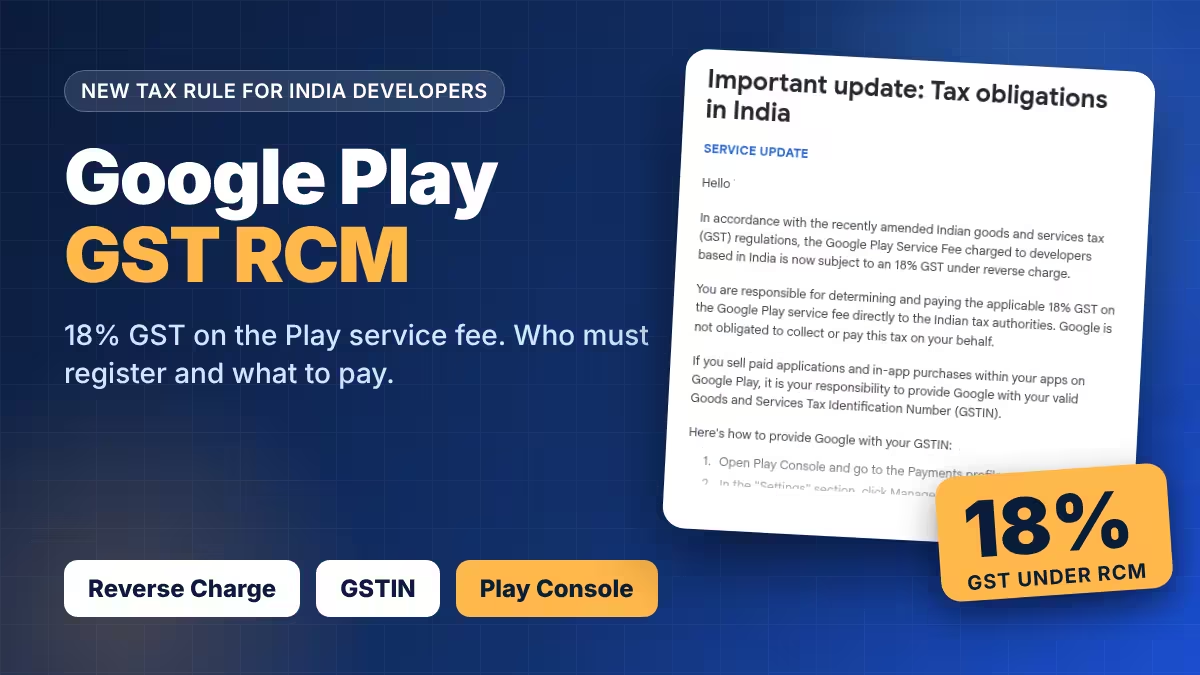
Google Play has started emailing India-based developers about a new tax obligation on the Play service fee. The email says the fee is now subject to 18% GST under reverse charge, and that developers must pay this tax themselves. This guide explains what changed, who it affects, and what you should do next.
What Does the Google Play GST RCM Email Mean
Google's email confirms that developers in India now carry the GST burden on the Play service fee.
The message, titled "Important update: Tax obligations in India," makes three points:
- The Google Play service fee charged to developers based in India now attracts 18% GST under reverse charge.
- You must work out and pay this GST directly to the Indian tax authorities. Google will not collect or pay it for you.
- If you sell paid apps or in-app purchases, you must give Google your valid GSTIN through Play Console.
The email closes by telling developers to consult a tax advisor, which tells you Google is leaving the compliance decisions to you.
Why Google Play Service Fee Now Attracts GST Under RCM
A change in the place of supply rule for intermediary services moved the Play fee into the GST net.
Google Commerce Limited, based in Ireland, bills the Play service fee. Earlier, Section 13(8)(b) of the IGST Act treated the supplier's location as the place of supply for intermediary services. With the supplier in Ireland, the place of supply sat outside India, so the fee did not count as an import of service.
The Finance Act 2026 omitted Section 13(8)(b), and the change took effect on 30 March. Intermediary services now follow the default rule under Section 13(2), which uses the recipient's location. When an Indian developer receives the service, the place of supply becomes India. The fee then qualifies as an import of service, and the developer pays GST on it under the reverse charge mechanism (RCM).
What Is Reverse Charge (RCM) on the Play Service Fee
Under reverse charge, you pay the tax instead of the supplier.
Normally a seller adds GST to the bill and pays it to the government. With RCM, the buyer calculates the tax and pays it. Here, Google is the seller and you are the buyer, so you pay 18% GST on whatever service fee Google deducts from your earnings.
For example, if Google deducts a ₹1,000 service fee in a month, your RCM liability on that fee is ₹180.
Who Must Register for GST as a Google Play Developer
The obligation applies to India-based developers who pay a Google Play service fee.
Google charges its service fee only when you sell digital goods or services through Play billing. That covers:
- Paid apps
- In-app purchases, including one-time unlocks
- Subscriptions
If your apps are free and earn only through ads such as AdMob, Google does not deduct a service fee, so this specific trigger does not apply to you. Your other income may still create GST duties, so check your full situation.
Section 24(iii) of the CGST Act makes registration compulsory for anyone liable to pay tax under reverse charge. The usual turnover threshold does not apply. In practice, this means even a solo developer with a small monthly fee may need a GST registration.
How to Add Your GSTIN in Play Console and Pay RCM
Act early, because liability builds up with every payout cycle.
- Open your Play Console earnings reports and check whether Google deducts a service fee from your payouts.
- If it does, speak to a CA who understands Google Play payouts before you register.
- Apply for GST registration on the GST portal if your CA confirms you need it.
- Add your GSTIN in Play Console under Payments profile, then Settings, then Manage settings, then India tax info.
- Pay the 18% RCM tax on the service fee for each period, and file your returns on time.
If your liability started months ago, ask your CA how to clear the pending tax and interest for those months. RCM tax you pay can usually be claimed back as input tax credit, subject to the usual conditions.
What Changes After GST Registration for App Developers
GST registration affects more than your Play Console account.
- It links to your PAN. Once you register, you report all taxable business activity under that PAN, including freelance or other business income.
- Monthly or quarterly returns follow. You will need to file returns even in months with little activity.
- Exports need extra paperwork. If you sell to users outside India, ask your CA about filing a Letter of Undertaking (LUT) so you can export without paying tax upfront.
- Some points are still unsettled. No official clarification yet covers every detail of how the intermediary rules apply to app store fees, so expect guidance to evolve.
Frequently Asked Questions
Does the Google Play GST RCM rule apply to free apps?
It does not apply through this route if your free app earns only from ads. Google charges a service fee only on paid apps, in-app purchases and subscriptions, and the RCM liability attaches to that fee.
Is there a minimum turnover limit for this GST registration?
No. Section 24(iii) of the CGST Act requires registration for anyone liable under reverse charge, whatever their turnover.
Will Google collect the GST on my behalf?
No. Google's email states it is not obliged to collect or pay this tax for developers based in India. You pay it directly.
Can I claim back the RCM GST I pay?
In most cases you can claim RCM tax as input tax credit once you register and meet the conditions. Your CA can confirm how this works with your other income.
When did the change take effect?
The Finance Act 2026 omitted Section 13(8)(b) of the IGST Act with effect from 30 March, so payout cycles from that point onward can carry RCM liability.
What happens if I ignore it?
The tax department can match Google's fee records to your PAN. If it flags you, you may face compulsory registration along with unpaid tax, interest and possible penalties.