A deal site flashes a banner: lifetime VPN access for about $40. No renewals, no monthly charges, no price hikes. Most paid VPNs cost $60 to $100 a year, so the offer pays for itself in under a year on paper.
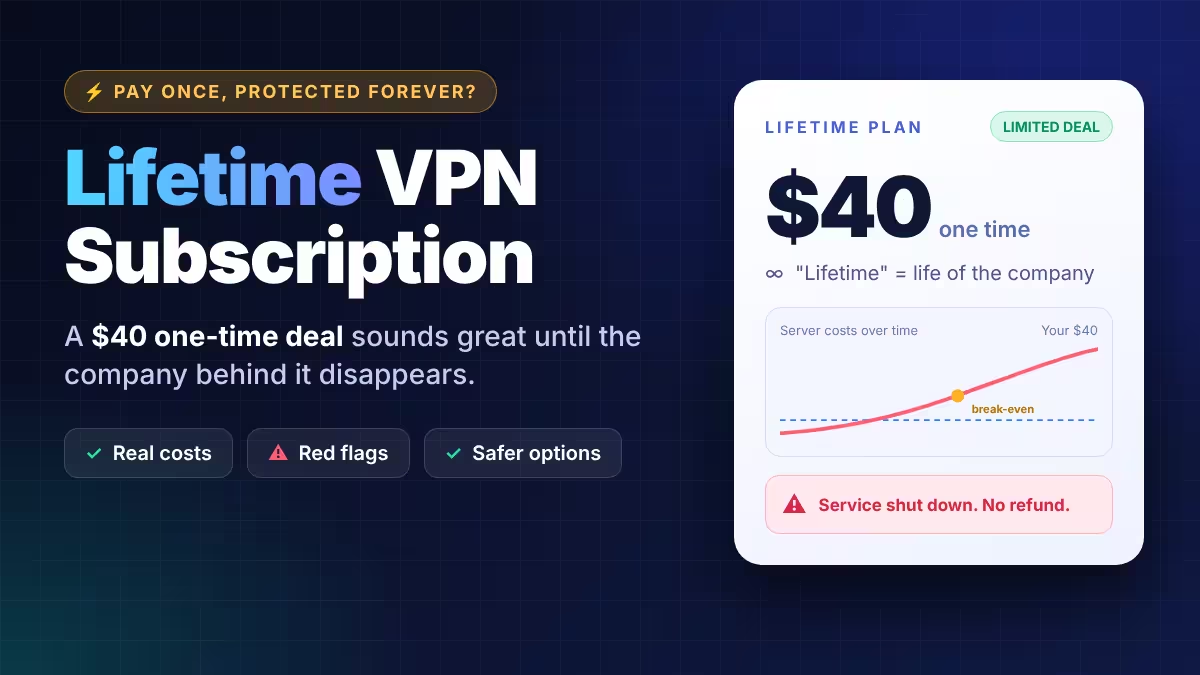
The catch sits in one word. "Lifetime" almost never means your lifetime. It means the life of the product, the plan, or the company that sold it to you. When that company folds, sells itself, or changes its terms, your "forever" access ends with it.
This guide breaks down how lifetime VPN plans make (or lose) money, which ones have already let buyers down, and how to decide whether a specific offer deserves your cash.
Is a Lifetime VPN Subscription Worth It?
For most people, a lifetime VPN subscription is a poor long-term bet. A VPN runs on rented servers and bandwidth that cost money every month, while a lifetime buyer pays only once. Some deals survive because a large base of regular subscribers covers the cost, but many cheap lifetime providers slow down, cut corners on security, or shut down within a few years. A discounted two or three year plan from an audited provider, or a reputable free tier, usually gives you better value with far less risk.
What Does "Lifetime" Really Mean in a VPN Deal?
Desktop software like a photo editor runs on your own computer. The developer ships the code once, and your processor does the work. A one-time price makes sense there.
A VPN works the other way around. Every minute you stay connected, your traffic passes through a server in a data center that the provider rents. The company pays for:
- Server rent and electricity in dozens of countries
- Wholesale bandwidth, which grows as you stream and download more
- App updates for new versions of Windows, macOS, Android, and iOS
- Security patches and protocol upgrades
- Customer support staff
- Independent no-logs audits
Those bills arrive every month. Your $40 arrives once. If you use the VPN daily for five years, you generate thousands of hours of server time against a payment that never grows. The provider carries an open-ended cost in exchange for a fixed fee.
Also check the fine print for the term length. Some deal marketplaces label a five-year license as "lifetime," and the account simply stops working when that clock runs out.
Why Lifetime VPN Plans Struggle to Stay Profitable
A company that sells lifetime plans needs some other source of money to keep the lights on. In practice, you see three patterns.
1. Subscribers pay for lifetime users: A large provider with millions of monthly and yearly customers runs a small, limited lifetime promotion. The regular subscribers quietly cover the server costs of the lifetime group. This model can hold up, as long as lifetime users stay a tiny slice of the total.
2. New buyers pay for old buyers: A smaller provider depends on a steady stream of fresh lifetime sales to fund bandwidth for everyone who already paid. Growth hides the problem for a while. Once sales slow, the company faces a growing crowd of users who generate costs and zero revenue.
3. Your data pays the bills: When the money runs short, some providers start logging and selling browsing data, injecting ads, or cutting server capacity. That defeats the reason you bought a VPN in the first place.
Pattern two usually slides into pattern three, or into a shutdown.
Lifetime VPN Providers That Shut Down or Changed Terms
You do not need to guess how this plays out. Several real cases show the risks.
- VPNSecure: New owners took over in April 2025 and cancelled existing lifetime accounts. People who had paid years earlier lost access overnight.
- CactusVPN: The service shut down in 2024. Lifetime access disappeared along with the company.
- VPNLand: Buyers who thought they had paid once later found recurring charges after their lifetime accounts turned into paid subscriptions.
- NordVPN: The company stopped offering lifetime plans. Any site that sells a "NordVPN lifetime subscription" today is pushing a scam or shared credentials that will stop working.
- Windscribe: The provider sold $30 to $49 lifetime plans in 2017 and 2018 to fund early growth, still honors those accounts, and has since retired the plan. The company has openly said the model does not make sense over the long run.
FastestVPN still sells a lifetime plan for around $40. It works, but it runs a smaller network of roughly 500 servers, which can get crowded at peak hours, and user reports point to buggy apps, especially on Android.
None of these buyers had a refund option once their access ended. The deal marketplaces that sold the codes do not refund purchases made years earlier either.
Do Real Lifetime VPN Subscriptions Still Exist?
Yes, but few are worth buying. A handful of small providers still sell one-time licenses, mostly through discount marketplaces. FastestVPN, for example, has listed a lifetime plan near $40 on those sites. Bigger names have moved away from the idea. NordVPN dropped its lifetime offers, and Windscribe stopped selling new ones while it keeps honoring the old accounts.
The pattern is clear: the companies with the most customers and the most to lose are the ones that walked away from lifetime pricing.
Lifetime VPN Cost: How to Calculate the Break-Even Point
Before you pay, run a simple calculation. Divide the lifetime price by the monthly cost of a comparable subscription.
Break-even months = Lifetime price ÷ Monthly subscription cost
| Option | Cost | Break-even vs. lifetime ($40) |
|---|---|---|
| Lifetime deal | $40 once | Baseline |
| Budget 3-year plan | About $2 per month | About 20 months |
| Typical 2-year plan | About $2.50 to $3.50 per month | About 12 to 16 months |
| Standard monthly plan | About $10 to $13 per month | About 3 to 4 months |
The lifetime deal only wins if the provider keeps running at full quality beyond that break-even point. If it degrades or closes after 18 months, you paid more per usable month than you would have on a cancellable multi-year plan from a stable company.
Compare plans that do the same job. A lifetime deal with one device, a data cap, or few server locations is not equal to a subscription with 10 devices and full features. Add the cost of any missing features to the lifetime side.
Red Flags That Signal a Lifetime VPN Scam
Walk away, or at least slow down, if you spot any of these signs.
- A rock-bottom price: Anything around $20 to $30 for "lifetime" barely covers a few years of support tickets, let alone bandwidth.
- Constant countdown timers: Fake "last chance" banners that never end suggest the seller needs cash right now.
- The deal lives only on coupon sites: If the provider's own website barely promotes its subscriptions, the company probably depends on one-time sales.
- No independent audit: If a provider cannot prove it runs a no-logs VPN, assume it may treat your data as a product.
- Hidden ownership: An anonymous parent company in an unclear jurisdiction gives you nobody to hold accountable.
- Odd payment methods: Pressure to pay through non-refundable or untraceable channels blocks chargebacks.
- Vague terms: Words like "unlimited," "forever," or "guaranteed" mean nothing unless the terms define them.
When Is a Lifetime VPN Deal Safe to Buy?
A lifetime plan is not automatically a scam. It can work if most of these points hold true:
- The provider has operated for at least five years
- Regular subscribers make up the bulk of its revenue
- It publishes independent VPN audits of its no-logs claims
- Its ownership and jurisdiction are clear
- It offers a real refund window you can use to test it
- You can afford to lose the full price if it shuts down
Even then, treat the purchase as a capped experiment, not a permanent solution. Save your receipt, the product page, and the terms somewhere outside the VPN account so you have proof if something changes.
Is There a Free Lifetime VPN?
Not in the sense of a one-time license, but a free plan that never expires comes close. Proton VPN's free tier counts as a free VPN with no data limit, with no time limit and no card requirement. It limits you to one device and a few server countries, and it blocks streaming and P2P traffic. Windscribe also runs a free plan with 10GB of data per month.
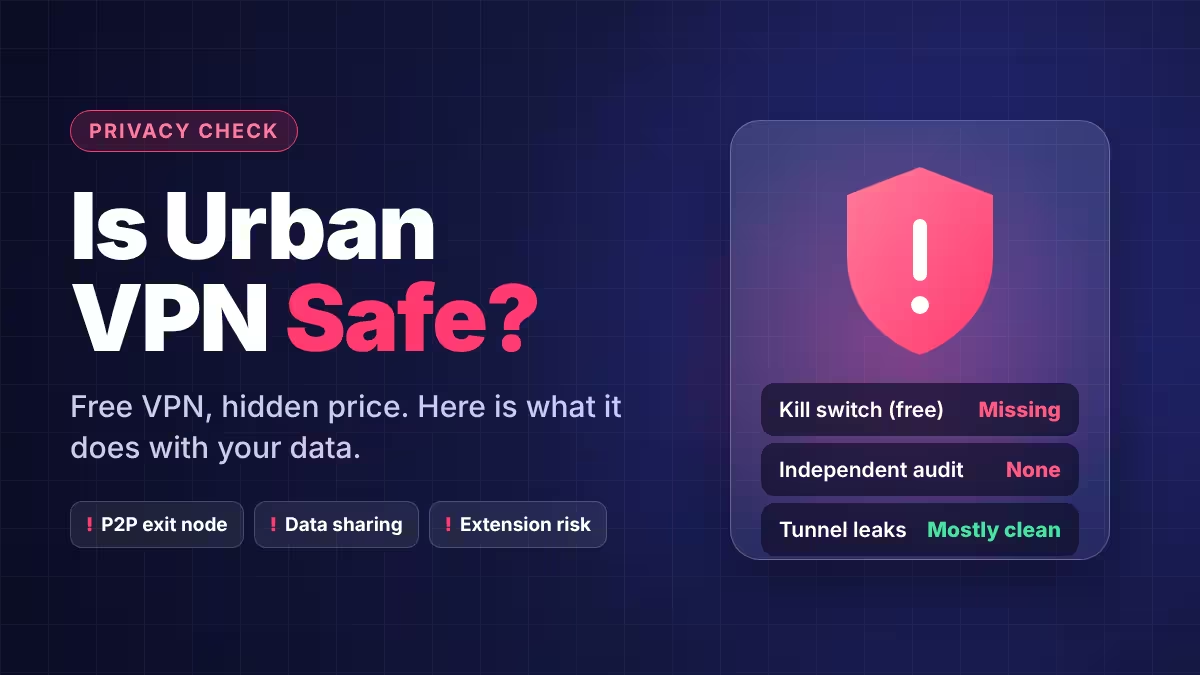
Be careful with free VPNs from unknown companies, such as the ones behind the Urban VPN safety debate. A service that charges nothing and shows no clear income source often pays its bills by logging and selling your browsing data. Pick a free plan only if the provider publishes independent audits and funds the free tier through paid plans.
Best Alternatives to a Lifetime VPN Subscription
Most people chase lifetime deals because they hate recurring charges and surprise renewal hikes. You can solve that problem without betting on a small company's survival.
Pick a long multi-year plan: Two or three year plans from audited providers often cost $2 to $3.50 per month. You pay upfront, skip monthly billing for years, and keep the option to switch later. Check the renewal price before you buy, since many providers renew at a much higher rate. Private Internet Access stands out for keeping its multi-year price stable at renewal.
Use a reputable free tier: Proton VPN offers a free plan with no data cap, no time limit, and no card required. It limits you to one device and a small set of countries, and it blocks streaming and P2P, but it never expires. Windscribe also offers a free plan with 10GB of data per month.
Pay only for what you use: Some providers let you build a smaller plan. Windscribe's Build-A-Plan, for example, charges $1 per server location per month with a $3 minimum.
Use the money-back window: Most major providers offer a 30-day guarantee. Run speed, leak, and streaming tests in the first week, and request a refund if the service falls short.
Set a renewal reminder: Put a calendar alert a few weeks before your term ends so you decide on renewal yourself instead of letting auto-renew decide for you.
Whatever you choose, buy directly from the provider's official website. A direct purchase keeps your account, refund rights, and renewal control in one place.
Lifetime VPN vs. Multi-Year Plan: Side-by-Side Comparison
| Factor | Lifetime VPN | Multi-Year Subscription |
|---|---|---|
| Upfront cost | About $30 to $50 once | About $50 to $90 for 2 to 3 years |
| Real duration | Until the company changes terms or closes | Fixed and clearly stated |
| Security updates | Often slow or stalled over time | Funded by ongoing revenue |
| Independent audits | Rare | Common among major providers |
| Server network | Usually smaller | Usually large and growing |
| Your leverage | Gone once you pay | Stop paying if quality drops |
| Refund if it shuts down | Almost never | Not needed, you can cancel and switch |
Frequently Asked Questions
Are lifetime VPN subscriptions a scam?
Not always, but many rely on a fragile business model. Cheap lifetime providers often end up with slow servers, outdated apps, weak support, or data logging as they try to stay afloat.
What happens to my lifetime VPN if the company shuts down?
You lose access, and you usually cannot get a refund. "Lifetime" refers to the life of the product or company, so the license ends when the service ends.
Does NordVPN sell a lifetime subscription?
No. NordVPN discontinued its lifetime offers. Treat any "NordVPN lifetime" listing as a scam or a reseller of shared accounts.
Is there a free VPN that lasts forever?
Proton VPN's free plan has no time limit and no data cap, so it comes closest to a free forever VPN. It limits you to one device and blocks streaming and P2P.
Is a lifetime VPN cheaper than a subscription in the long run?
Only if the provider keeps delivering full quality well past the break-even point. A $40 lifetime deal breaks even against a $2 per month plan after about 20 months, and many cheap lifetime services decline before or around that point.
What should I check before buying a lifetime VPN?
Check the company's age, audit history, ownership, refund policy, device limit, data cap, and the exact definition of "lifetime" in the terms. Only spend an amount you can afford to lose.
Why do most VPNs charge monthly or yearly?
A VPN has ongoing costs for servers, bandwidth, updates, support, and audits. Recurring payments match those recurring costs and keep the service funded.
Related Guides
- Is Urban VPN Safe? Privacy Claims Explained and Safer VPN Alternatives
- Best Free VPN With No Data Limit: 5 Unlimited Options Tested and Compared
- How to Choose a No-Logs VPN: Key Features to Check in 2026
- Do VPN Audits Actually Prove a VPN Is Safe? What a VPN Audit Can and Cannot Tell You
- Best VPN for Streaming Live Sports and TV Shows Abroad: Top 6 Tested and Ranked