Google and OpenAI shipped their newest models within the same week. Google released Gemini 4 Hydrogen on November 12, and OpenAI answered five days later with GPT-6.2 Astra on November 17. Both companies pitch these models as major upgrades, but they target very different buyers.
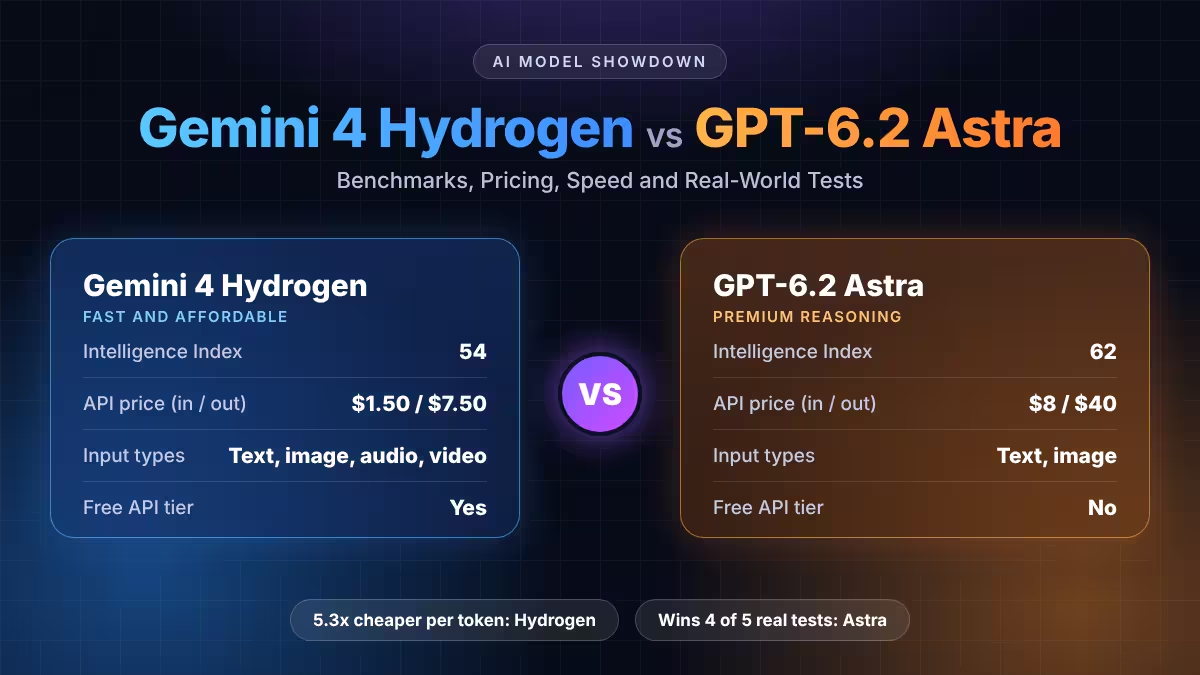
Astra is OpenAI's premium model for hard professional work. Hydrogen is Google's fast, affordable workhorse that replaced Gemini 3.8 Flash in the Gemini app. So the real question is not which model is smarter. It is whether Astra's extra quality justifies a price that runs more than five times higher.
We compared both models on independent benchmarks, API pricing, speed, context limits, input types and hands-on task results.
Gemini 4 Hydrogen vs GPT-6.2 Astra: Which Is Better?
GPT-6.2 Astra wins on raw intelligence, coding, agent tasks and careful reasoning. Gemini 4 Hydrogen wins on price, speed, multimodal input and free access. Pick Astra when a wrong answer costs you money or time. Pick Hydrogen when you run high volumes, process audio or video, or want a capable model without paying for it.
Gemini 4 Hydrogen vs GPT-6.2 Astra Specs Compared
| Feature | Gemini 4 Hydrogen | GPT-6.2 Astra |
|---|---|---|
| Developer | OpenAI | |
| Release date | November 12 | November 17 |
| API input price (per 1M tokens) | $1.50 | $8.00 |
| API output price (per 1M tokens) | $7.50 | $40.00 |
| Free API tier | Yes | No |
| Input context | 1,048,576 tokens (shared with output) | 1,050,000 tokens |
| Max output | Up to the full shared window | 128,000 tokens |
| Input types | Text, image, audio, video, PDF | Text and image |
| Output types | Text | Text |
| Knowledge cutoff | Not disclosed | Mid-May |
| License | Proprietary | Proprietary |
Benchmark Results: Does Astra's Intelligence Lead Hold at Every Effort Level?
On the Artificial Analysis Intelligence Index, GPT-6.2 Astra scores higher than Gemini 4 Hydrogen at every effort setting both models share.
| Effort setting | GPT-6.2 Astra | Gemini 4 Hydrogen |
|---|---|---|
| Max | 62 | Not offered |
| Xhigh | 62 | 54 |
| High | 60 | 51 |
| Medium | 57 | 41 |
| Low | 46 | 27 |
Astra leads at every matched setting. Even Astra on medium effort (57) beats Hydrogen at its top xhigh setting (54). The gap widens at the low end, where Astra scores 46 and Hydrogen drops to 27.
The same pattern holds across professional domains. At their top settings, Astra scores 61 in finance and accounting against Hydrogen's 58, 63 in strategy and operations against 58, 59 in legal work against 57, and 57 in healthcare against 53. Hydrogen stays competitive in legal and finance tasks, where the gap shrinks to two or three points.
On individual shared benchmarks, Astra wins all four that both models report: Agents' Last Exam, Ramp SWE-Bench v2, Ramp SWE-Bench v2 (Bash) and Terminal-Bench-Science 0.1, where Astra posts 77.1%. Hydrogen has no win on any shared test.
Which Is Better for Coding: Hydrogen or Astra?
Astra holds a clear edge for developers. On FrontierCode 2.0, a test that checks whether code changes are good enough to merge, Astra reaches 44.2% at max effort. Hydrogen scores 39.0% on the Artificial Analysis run of the same benchmark.
Astra also leads Terminal-Bench-Science and both Ramp SWE-Bench variants. OpenAI built Astra for agent loops and long coding sessions, and it runs inside Codex on paid ChatGPT plans.
Hydrogen still makes sense for lighter coding work. Its speed and low token cost suit autocomplete, quick refactors, test generation and code review in bulk, where you call the model thousands of times a day.
Gemini 4 Hydrogen vs GPT-6.2 Astra API Pricing
Price is where Hydrogen pulls far ahead. Google charges $1.50 per million input tokens and $7.50 per million output tokens for Hydrogen, and it offers a free API tier. OpenAI charges $8 and $40 for Astra, which already sits 20% below the older GPT-6 Astra rate of $10 and $50.
On a blended 3:1 input to output mix, Hydrogen costs about 5.3 times less per token. Astra also adds a long-prompt surcharge. Once a request passes 272,000 input tokens, OpenAI doubles the input rate and raises the output rate by 1.5 times for the whole request. Hydrogen lists no such surcharge.
Here is what a monthly workload of 10 million input tokens and 2 million output tokens costs at list rates:
| Model | Input cost | Output cost | Total |
|---|---|---|---|
| Gemini 4 Hydrogen | $15 | $15 | $30 |
| GPT-6.2 Astra | $80 | $80 | $160 |
Why Cheaper Tokens Don't Always Mean a Cheaper Task
Token price does not tell the full story, because models use different amounts of tokens to finish a job. Artificial Analysis measures the actual cost and time each model needs for one index task.
| Setting | Cost per task | Time per task |
|---|---|---|
| Astra max | $4.00 | 14.3 min |
| Astra high | $2.07 | 6.2 min |
| Astra medium | $1.62 | 4.8 min |
| Astra low | $0.66 | 2.0 min |
| Hydrogen xhigh | $3.16 | 15.7 min |
| Hydrogen high | $1.87 | 8.8 min |
| Hydrogen medium | $0.80 | 4.1 min |
| Hydrogen low | $0.29 | 1.5 min |
This table changes the picture. Hydrogen at xhigh costs $3.16 per task and scores 54. Astra at medium costs $1.62 and scores 57. So for top-quality output, Astra on a mid setting delivers more intelligence for less money than Hydrogen pushed to its limit.
Hydrogen wins clearly at the bottom of the range. At low effort it finishes a task in 1.5 minutes for $0.29, the fastest and cheapest option of all nine configurations.
Which Model Responds Faster?
Hydrogen responds fast. On OpenRouter it generates a median of 111 tokens per second, more than double the 45 tokens per second that OpenAI's sibling model GPT-6.2 Sol produces.
Time to first answer also favors lower settings on both sides. Astra at max effort takes over 200 seconds before it writes the first answer token, while Astra at low starts in under 3 seconds. Hydrogen at low starts in about 6 seconds and at xhigh in about 51 seconds. For chat apps and voice agents, run either model at low or medium effort.
Context Window and Max Output Limits
Both models accept roughly one million tokens of input. Astra takes 1,050,000 input tokens, slightly more than Hydrogen's 1,048,576.
Output is a different story. Astra caps each response at 128,000 tokens. Hydrogen shares its full window between input and output, so it can produce far longer responses when the input is short. That matters for long reports, full code files and bulk translation jobs.
Audio, Video and Image Support: Hydrogen vs Astra
Hydrogen accepts text, images, audio, video and PDFs natively in one model. You can feed it a recorded meeting, a product demo video or a scanned contract and ask questions about it directly.
Astra accepts only text and images, and it returns text. If your workflow involves audio or video files, Hydrogen handles them without any extra transcription or frame extraction step.
Real-World Test: 5 Tasks Run on Both Models
Benchmarks only show part of the picture, so a five-task real-world test put both models through planning, writing, app building, crisis management and logic problems. Astra won four of the five rounds.
Conference scheduling. Both models built a clean schedule for six speakers across three rooms. Astra spotted both conflicts around the closing keynote and listed the exceptions that needed approval. Hydrogen produced an easy-to-read table but treated the individual talks as the whole job and missed the keynote clash. Astra won.
Creative writing. Both models opened a mystery story with an exact seven-word sentence and avoided the banned words. Astra built a quietly threatening conversation and an ending that changed how the reader saw the opening. Hydrogen wrote a clear, readable opening, but its final reveal only set up the next scene. Astra won.
Building a web app. The prompt asked for a weighted decision tool with charts, sensitivity analysis and a "what if" mode. Both models delivered working, responsive apps with live calculations. Astra added a separate slider section that let users test weights without touching the originals, which made its build more useful. Astra won.
Bookstore crisis plan. Both models faced a signing event with too few books, a sick employee, an offline payment system and a curious journalist. Astra gave inexperienced staff narrow roles, kept exits clear and avoided promises it could not keep. Hydrogen offered practical ideas but committed to dates and arrangements its own plan said still needed confirmation. Astra won.
Logic puzzle. The puzzle contained deliberate contradictions. Both models recognized it had no valid solution instead of inventing one. Hydrogen explained the three contradictions with slightly better clarity and layout. Hydrogen won narrowly.
The takeaway: Astra handles constraints and unstated risks more carefully. Hydrogen does solid work but sometimes fills gaps with assumptions, so you should double-check its output on high-stakes tasks.
How to Access Gemini 4 Hydrogen and GPT-6.2 Astra
Gemini 4 Hydrogen runs in the Gemini app, where it replaced Gemini 3.8 Flash. Free users reach it when the Auto mode routes a harder prompt to it, and a Gemini usage limit still applies. Google AI Plus, AI Pro and AI Ultra subscribers can select it directly. Google's higher-tier Gemini 4 Argon sits on paid plans. Developers can call it through the Gemini API with a free tier (see how to get a free Gemini API key), through Vertex AI on Google Cloud and through OpenRouter.
GPT-6.2 Astra runs inside ChatGPT Work and Codex on paid plans, including Plus. OpenAI has not added it to the regular ChatGPT chat tab, and Free and ChatGPT Go users cannot access it. Developers can call it through the OpenAI API with the model ID gpt-6.2-astra, or through OpenRouter. OpenAI also offers an Ultrafast option for Astra in the API.
Should You Choose Hydrogen or Astra?
Choose GPT-6.2 Astra if you:
- Need the highest reasoning quality for professional documents, analysis or research
- Run coding agents or multi-step agent workflows
- Work on tasks where a wrong assumption causes real damage
- Already pay for ChatGPT Plus or higher and use Work or Codex
Choose Gemini 4 Hydrogen if you:
- Process large volumes of requests and need to control your API bill
- Work with audio, video or PDF files
- Want fast responses for chat tools, summaries or classification
- Need a free option for testing or personal projects
- Generate very long outputs in a single response
Many teams will get the best results by routing work between both. Send routine, high-volume jobs to Hydrogen and reserve Astra for the hard problems where accuracy pays for itself.
Frequently Asked Questions
Is GPT-6.2 Astra better than Gemini 4 Hydrogen?
Yes, on quality. Astra scores 62 on the Artificial Analysis Intelligence Index against Hydrogen's 54 and wins every shared benchmark that both models report. Hydrogen wins on price, speed and multimodal input.
How much cheaper is Gemini 4 Hydrogen than GPT-6.2 Astra?
Hydrogen costs about 5.3 times less per token. Google charges $1.50 input and $7.50 output per million tokens, while OpenAI charges $8 and $40 for Astra. Hydrogen also offers a free API tier.
Is Gemini 4 Hydrogen free to use?
Free Gemini app users can reach Hydrogen when Auto mode sends a harder prompt to it, but they cannot pick it manually. The Gemini API also includes a free tier for Hydrogen. Paid Google AI plans let you select it directly.
Can GPT-6.2 Astra process video or audio?
No. Astra accepts only text and images as input. Hydrogen accepts text, images, audio, video and PDFs.
Which model is better for coding?
Astra leads on coding benchmarks, including FrontierCode 2.0 (44.2% against 39.0%) and both Ramp SWE-Bench variants. Hydrogen works well for fast, high-volume coding tasks where cost matters more than peak accuracy.
Which model is faster?
Hydrogen generates around 111 tokens per second on OpenRouter and finishes a low-effort index task in 1.5 minutes. Astra at low effort takes about 2 minutes per task.
Can I use GPT-6.2 Astra in the free version of ChatGPT?
No. Astra runs only in ChatGPT Work and Codex on paid plans, starting with Plus. It does not appear in the regular chat tab.
Related Guides
- Gemini 4 Argon: How to Access It, Which Plans Get It and API Pricing
- How to Get a Free Gemini API Key from Google AI Studio: Steps, Limits and Safety
- How to Check and Manage Your Gemini Usage Limit (Before You Get Locked Out)
- ChatGPT Go Global Launch Brings Nearly Doubled Usage Limits at $8
- OpenAI Codex for Open Source Program Offers Free ChatGPT Pro and API Credits